Sugar Creek Trading Company
Mistletoe Herb
Mistletoe Herb
Couldn't load pickup availability
VISCUM ALBUM
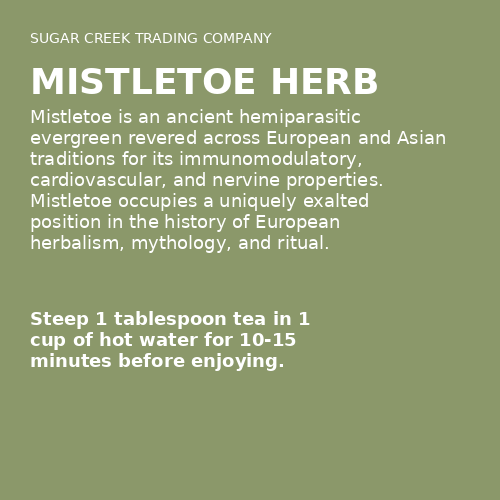
Ancient hemiparasitic evergreen revered across European and Asian traditions for its immunomodulatory, cardiovascular, and nervine properties.
BOTANICAL IDENTIFICATION
Scientific Name: Viscum album L.
Common Names: Mistletoe herb, European mistletoe, common mistletoe, birdlime mistletoe, all-heal, herbe de la croix, Mistel, gui
Family: Santalaceae (formerly Viscaceae / Loranthaceae)
Viscum album is an evergreen hemiparasitic shrub that forms dense, spherical clusters 30 to 100 centimeters in diameter on the branches of host trees. It produces opposite pairs of leathery, yellowish-green, oblong leaves and small, inconspicuous yellowish flowers. The white, translucent berries are approximately 6 to 10 millimeters in diameter and contain a single seed embedded in an extremely viscous, sticky pulp called viscin, which allows the seeds to adhere to new host branches after being deposited by birds.
This species is native to Europe and western and southern Asia, where it grows as a partial parasite on a wide range of deciduous and coniferous host trees including apple, oak, poplar, lime, hawthorn, and pine. It penetrates the host's bark with specialized root structures called haustoria, drawing water and mineral nutrients while still photosynthesizing through its own evergreen leaves.
CULTURAL AND HISTORICAL USE
Mistletoe occupies a uniquely exalted position in the history of European herbalism, mythology, and ritual. The Roman naturalist Pliny the Elder recorded in the first century CE that the Druids of Gaul considered mistletoe growing on oak trees to be the most sacred of all plants, harvesting it with a golden sickle on the sixth day of the moon in a ceremony accompanied by the sacrifice of white bulls. The plant's ability to remain green and bear fruit through the dead of winter, while suspended between earth and sky on the bare branches of its host, gave it an aura of supernatural power across Celtic, Norse, and Germanic cultures. In Norse mythology, mistletoe is central to the story of Baldur's death, and its association with peace and reconciliation gave rise to the enduring custom of kissing beneath the mistletoe.
In European folk medicine, mistletoe has been employed for centuries as a treatment for epilepsy, hypertension, headaches, and nervous disorders. The Greek physician Hippocrates used it for complaints of the spleen, and Paracelsus recommended it for falling sickness. In the traditional medicine of Austria and Switzerland, mistletoe tea prepared from the dried herb was a well-known remedy for high blood pressure and circulatory complaints. The English herbalist Nicholas Culpeper described it in the seventeenth century as effective against apoplexy and palsy.
In the twentieth century, mistletoe was championed by Rudolf Steiner, founder of anthroposophic medicine, who proposed its use in integrative oncology based on the observation that mistletoe, as a parasite, mirrors the behavior of tumors within a host organism. This led to the development of injectable mistletoe preparations such as Iscador and Helixor, which are among the most widely prescribed complementary therapies in German and Swiss integrative oncology today.
KEY BIOACTIVE COMPOUNDS & BENEFITS
| Compound/Class | Location in Plant | Human Benefit | Role in Plant |
|---|---|---|---|
| Viscotoxins (A1, A2, A3, B, 1-PS) | Leaves and stems | Cytotoxic and immunostimulant activity; stimulate nonspecific immune responses | Antimicrobial defense proteins |
| Lectins (ML-I, ML-II, ML-III) | All aerial parts | Potent immunomodulators; induce cytokine release, activate natural killer cells and macrophages | Defense against herbivory and pathogens |
| Flavonoids (quercetin, flavoyadorinin B) | Leaves | Antioxidant and anti-inflammatory activity; support vascular health | UV protection and signaling |
| Phenylpropanoids (syringin, caffeic acid) | Stems and leaves | Mild hypotensive and cardioprotective effects | Structural and defensive compounds |
| Polysaccharides (galacturonans, arabinogalactans) | All aerial parts | Immune-enhancing activity; support gut-associated lymphoid tissue | Cell wall structure and water retention |
The therapeutic profile of mistletoe herb is defined by the interplay between its lectins and viscotoxins, which together produce a complex immunomodulatory effect that is dose-dependent: lower doses tend to stimulate immune function, while the overall profile supports both innate and adaptive immune responses. The flavonoid and phenylpropanoid content contributes additional cardiovascular and antioxidant benefits that complement the immunological activity.
HOW IT WORKS IN THE BODY
Mistletoe herb exerts its effects through multiple physiological pathways, with its most studied actions centering on immune modulation, cardiovascular regulation, and nervous system support.
Immune Modulation and Cytokine Activation:
Mistletoe lectins, particularly ML-I (viscumin), bind to galactose residues on the surface of immune cells, triggering a cascade of immunological responses. These include increased secretion of interleukin-1, interleukin-6, and tumor necrosis factor-alpha (TNF-alpha) from monocytes and macrophages, as well as enhanced activity of natural killer (NK) cells. Studies published in Phytomedicine and the European Journal of Medical Research have documented significant increases in NK cell cytotoxicity and T-helper cell counts following mistletoe administration.
Cardiovascular and Hypotensive Effects:
The flavonoids and phenylpropanoid glycosides in mistletoe support vasodilation and have been shown to produce mild but reproducible reductions in blood pressure. The mechanism appears to involve both direct relaxation of vascular smooth muscle and modulation of the parasympathetic nervous system. Traditional use for hypertension is supported by pharmacological evidence showing acetylcholine-mediated vasodilation in animal models.
Nervine and Anxiolytic Activity:
Mistletoe has a long tradition of use as a calming nervine for anxiety, restlessness, and nervous headaches. Its sedative properties are attributed in part to its flavonoid content and its overall regulatory effect on the autonomic nervous system. It has been used historically in combination with valerian and hawthorn for stress-related cardiovascular symptoms such as nervous palpitations.
DOSE GUIDELINES
| Preparation Type | Typical Dose | Purpose |
|---|---|---|
| Cold infusion (preferred) | 2 to 4 grams dried herb steeped in cold water overnight, strained and drunk in divided doses | Traditional cardiovascular and nervine support |
| Tincture (1:5, 45% ethanol) | 1 to 3 mL, two to three times daily | Immune and nervous system support |
| Dried herb in capsules | 500 to 1,000 mg, two to three times daily | General immune maintenance |
Mistletoe herb is traditionally prepared as a cold-water infusion rather than a hot tea. The cold extraction is preferred because it draws out the beneficial lectins and flavonoids while minimizing the extraction of viscotoxins, which are more readily released by heat. The herb steeped overnight in room-temperature or cold water and strained the following morning yields a preparation that has been used safely in European phytotherapy for generations. It is best used over extended periods of several weeks to months for cardiovascular and nervine support.
PREPARATION AND USES
The most traditional preparation of mistletoe herb is the cold infusion: place 2 to 4 grams (about one to two teaspoons) of the dried, cut herb in a cup of cold or room-temperature water, cover, and allow to steep for 8 to 12 hours or overnight. Strain and drink the infusion in two to three divided doses throughout the day. This cold extraction method is specifically recommended in the German and Austrian herbal traditions and is endorsed by sources including the German Commission E. Some practitioners gently warm the strained liquid to a comfortable drinking temperature, but prolonged boiling should be avoided.
Mistletoe tincture is another common preparation, typically made at a 1:5 ratio with 45 percent ethanol. It can be combined with hawthorn berry tincture for cardiovascular support or with valerian and passionflower for nervine formulas. The dried herb can also be powdered and encapsulated for those who prefer a more convenient form. Topically, mistletoe preparations have been used in traditional European herbalism as compresses for joint pain and rheumatic complaints, though internal use is far more common.
OPTIMAL CONTEXT FOR USE
This herb is especially well-suited for individuals experiencing:
Mild to moderate hypertension and circulatory irregularities, particularly when associated with stress or nervous tension
Weakened or sluggish immune function where gentle, sustained immunomodulatory support is desired
Anxiety, restlessness, and nervous headaches that are connected to cardiovascular symptoms such as palpitations or tightness
Integrative wellness protocols where immune system support is a component of a broader holistic strategy
Age-related cardiovascular concerns where long-term, gentle vascular support is appropriate
Mistletoe herb combines well with hawthorn for cardiovascular formulas, with linden flower for hypertension and relaxation, and with astragalus or reishi for comprehensive immune support protocols.
SUSTAINABILITY AND ETHICAL HARVESTING
Viscum album is widespread throughout Europe and Asia and is not considered threatened or endangered. In fact, in many orchard and forestry contexts, mistletoe is regarded as a pest species because heavy infestations can weaken and eventually kill host trees, particularly fruit trees. Harvesting from wild populations is therefore often ecologically neutral or even beneficial to host tree health. Commercial mistletoe is primarily wild-harvested from apple, poplar, and lime trees in central and eastern Europe.
The primary sustainability concern with mistletoe relates to the broader health of the forest ecosystems where it grows. Responsible harvesters avoid stripping all mistletoe from a given area, as the berries are an important winter food source for mistle thrushes, blackcaps, and other bird species that rely on them during the cold months. Ethical sourcing supports balanced harvesting that maintains the plant's ecological role while meeting commercial demand.
SAFETY AND CAUTIONS
Mistletoe herb prepared as a cold infusion or low-dose tincture from Viscum album has a long history of safe use in European herbal medicine. However, important cautions apply.
Berry toxicity: The white berries of mistletoe are considered mildly toxic and should not be consumed. Herbal preparations use the dried leaves and stems only. While serious poisoning from berry ingestion is rare in adults, berries should be kept away from children.
Species confusion: American mistletoe (Phoradendron leucarpum) is a different species with a different chemical profile and should not be substituted for European Viscum album in herbal preparations.
Drug interactions: Mistletoe may potentiate the effects of antihypertensive medications, cardiac glycosides, and immunosuppressive drugs. Consult a healthcare provider if you are taking any of these medications.
Pregnancy and nursing: Mistletoe herb is contraindicated during pregnancy due to its uterine-stimulating properties. It should also be avoided during breastfeeding due to insufficient safety data.
Autoimmune conditions: Due to its immunostimulatory effects, mistletoe should be used with caution by individuals with autoimmune disorders. Professional guidance is recommended.
REFERENCES
Kienle, G. S., and Kiene, H. "Complementary cancer therapy: A systematic review of prospective clinical trials on anthroposophic mistletoe extracts." European Journal of Medical Research, 12(3), 2007, pp. 103-119.
Blumenthal, M., et al., eds. The Complete German Commission E Monographs: Therapeutic Guide to Herbal Medicines. American Botanical Council, 1998. Monograph: Visci albi herba.
Urech, K., et al. "Viscotoxin and mistletoe lectin contents in Viscum album L.: Influence of host tree, collection site, and sampling time." Phytochemistry, 65(10), 2004, pp. 1313-1321.
FINAL NOTE
Mistletoe herb bridges the deep mythological past and the modern pharmacological present like few other plants. Its unique biology as a hemiparasite that thrives between worlds mirrors its traditional role as a mediator between opposing forces in the body: it calms the nervous system while stimulating the immune system, and it gently lowers blood pressure while supporting vascular tone. A cold-water infusion of this ancient herb connects the user to a lineage of European healing that stretches back beyond recorded history.
Share