Sugar Creek Trading Company
Moruga Scorpion Hot Pepper 600 000hu
Moruga Scorpion Hot Pepper 600 000hu
Couldn't load pickup availability
CAPSICUM CHINENSE
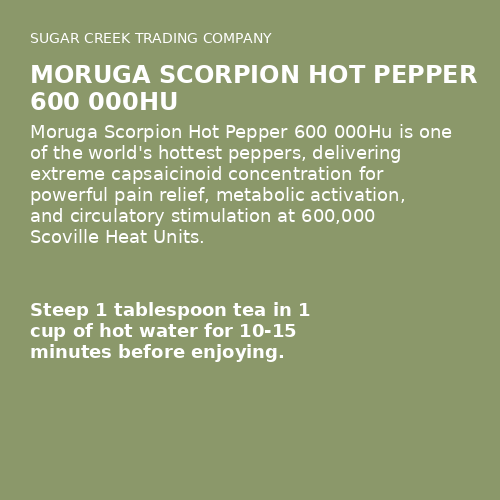
One of the world's hottest peppers, delivering extreme capsaicinoid concentration for powerful pain relief, metabolic activation, and circulatory stimulation at 600,000 Scoville Heat Units.
BOTANICAL IDENTIFICATION
Scientific Name: Capsicum chinense Jacq. (cultivar: Trinidad Moruga Scorpion)
Common Names: Moruga Scorpion pepper, Trinidad Moruga Scorpion, Moruga Scorpion hot pepper, scorpion chili
Family: Solanaceae (Nightshade family)
The Trinidad Moruga Scorpion is a cultivar of Capsicum chinense, a perennial species (grown as an annual in temperate climates) that produces bushy plants reaching 60 to 120 centimeters in height. The fruit is distinctively shaped: roughly globular to slightly elongated, 3 to 5 centimeters in diameter, with deeply ridged, bumpy, puckered skin that terminates in a pointed "tail" reminiscent of a scorpion's stinger. Fruit color matures from green through orange to a deep, glossy red. The placental tissue inside the fruit, where the seeds attach, is the primary site of capsaicinoid production and the source of its extreme heat.
This cultivar originated in the village of Moruga in the southern region of Trinidad and Tobago. In 2012, the New Mexico State University Chile Pepper Institute confirmed the Trinidad Moruga Scorpion as the world's hottest pepper, with individual fruits averaging over 1.2 million Scoville Heat Units (SHU) and some specimens exceeding 2 million SHU. This product, rated at 600,000 SHU, represents the dried and ground form, which provides a consistently high but manageable heat level for culinary, therapeutic, and topical applications.
CULTURAL AND HISTORICAL USE
The Capsicum chinense species, despite its misleading name (given by Dutch botanist Nikolaus von Jacquin who mistakenly believed it originated in China), is native to the Amazon Basin of South America, with a center of diversity spanning lowland Bolivia, Peru, and Brazil. Archaeological evidence shows that Capsicum species were among the first plants domesticated in the Americas, with evidence of cultivation dating to at least 6,000 years ago. The chinense species was carried throughout the Caribbean by indigenous peoples, where it diversified into hundreds of local varieties including the habanero, Scotch bonnet, and the superhot cultivars of Trinidad.
In Trinidadian culture, hot pepper is central to cuisine and identity. The Moruga Scorpion was developed and maintained by local farmers in the rural Moruga district, a predominantly Indo-Trinidadian agricultural community with deep traditions of pepper cultivation. Caribbean culinary tradition uses these extreme peppers in hot sauces, pepper mashes, jerk marinades, and curry pastes, where small quantities provide layers of fruity, floral heat behind the burn. The Moruga Scorpion is noted not only for its extreme Scoville rating but for its unusually complex flavor profile, with sweet, fruity, and almost citrus-like notes that emerge beneath the overwhelming heat.
Beyond cuisine, hot peppers have a long history in traditional medicine across the Americas and Asia. Mayan and Aztec healers used capsicum preparations for toothache, sore throat, and digestive complaints. In Traditional Chinese Medicine, cayenne and other hot peppers are classified as acrid and hot, used to expel cold, stimulate circulation, and open blocked channels. In Western herbalism, capsicum has been a cornerstone stimulant herb since at least the era of Samuel Thomson in the early nineteenth century, who considered it one of the most important remedies in his entire system of botanical medicine.
KEY BIOACTIVE COMPOUNDS & BENEFITS
| Compound/Class | Location in Plant | Human Benefit | Role in Plant |
|---|---|---|---|
| Capsaicin (8-methyl-N-vanillyl-6-nonenamide) | Placental tissue and seeds (highest); distributed through flesh | Analgesic via TRPV1 desensitization; thermogenic; circulatory stimulant; releases endorphins | Mammalian deterrent; protects seeds from destruction by mammalian teeth while allowing bird dispersal |
| Dihydrocapsaicin | Placental tissue and flesh | Second most abundant capsaicinoid; contributes to sustained, diffuse heat sensation; analgesic | Synergistic mammalian deterrent |
| Carotenoids (capsanthin, capsorubin, beta-carotene) | Fruit flesh and skin | Potent antioxidants; support eye health, skin integrity, and immune function; responsible for red color | Photoprotection and fruit coloring for bird dispersal |
| Vitamin C (ascorbic acid) | Fruit flesh | Immune support, collagen synthesis, and enhanced iron absorption; hot peppers are among the richest vitamin C sources | Antioxidant protection during fruit ripening |
| Steroidal saponins and flavonoids (luteolin, quercetin) | Fruit flesh and skin | Anti-inflammatory and antioxidant synergy with capsaicinoids | Pathogen defense and UV screening |
At 600,000 SHU, the Moruga Scorpion delivers an exceptionally high concentration of total capsaicinoids, primarily capsaicin and dihydrocapsaicin, which together account for approximately 90 percent of the pungency. The extreme capsaicinoid content means that very small quantities produce profound physiological effects, making this pepper suitable for both potent therapeutic preparations and intensely flavored culinary applications where only a pinch is required.
HOW IT WORKS IN THE BODY
Capsaicin is one of the most pharmacologically well-characterized plant compounds in existence, with clearly defined molecular targets and extensively documented physiological effects.
Pain Relief via TRPV1 Receptor Desensitization:
Capsaicin binds to the transient receptor potential vanilloid 1 (TRPV1) receptor, a calcium channel on sensory neurons that normally responds to heat, acid, and certain inflammatory mediators. Initial binding triggers the burning sensation and causes the release of substance P, a neuropeptide involved in pain signaling. With repeated or sustained exposure, the neuron becomes desensitized: substance P stores are depleted, the TRPV1 receptor is downregulated, and the nerve fiber's ability to transmit pain signals is temporarily diminished. This mechanism is the basis for capsaicin-based topical analgesics used clinically for neuropathic pain, osteoarthritis, and postherpetic neuralgia, as documented in systematic reviews in The Cochrane Database of Systematic Reviews.
Thermogenesis and Metabolic Activation:
Capsaicin activates brown adipose tissue (BAT) and increases diet-induced thermogenesis through TRPV1-mediated sympathetic nervous system activation. This results in increased caloric expenditure, enhanced fat oxidation, and reduced appetite. A meta-analysis published in Appetite found that capsaicin consumption increased energy expenditure by an average of 50 kcal per day and reduced ad libitum energy intake. At the concentration found in the Moruga Scorpion, even very small amounts produce significant thermogenic effects.
Cardiovascular and Circulatory Stimulation:
Capsaicin promotes vasodilation through the release of calcitonin gene-related peptide (CGRP) and nitric oxide from sensory nerve endings in blood vessel walls. This improves peripheral blood flow, reduces blood pressure, and enhances the delivery of nutrients and oxygen to tissues. The stimulant effect on circulation has made capsicum a traditional "catalyst herb" in Western herbalism, used to enhance the absorption and distribution of other herbs in compound formulas.
Endorphin Release and Mood Enhancement:
The intense TRPV1 activation caused by high-Scoville peppers triggers the release of endorphins and enkephalins, endogenous opioid peptides that produce feelings of euphoria, well-being, and pain relief. This neurochemical response is responsible for the "pepper high" or "chili rush" experienced by enthusiasts of superhot peppers and contributes to the psychologically rewarding nature of spicy food consumption.
DOSE GUIDELINES
| Preparation Type | Typical Dose | Purpose |
|---|---|---|
| Dried ground pepper (culinary) | A small pinch to 1/8 teaspoon per dish | Extreme heat flavoring; metabolic stimulation |
| Capsules (powdered pepper) | 50 to 200 mg per capsule, one to three times daily with meals | Circulatory support, thermogenesis, and digestive stimulation |
| Infused oil or liniment (topical) | Apply small amounts of infused oil to affected area; test on small skin patch first | Topical pain relief for joint and muscle discomfort |
| Hot sauce or tincture base | Drops to taste (this pepper is far hotter than cayenne; use extreme caution) | Catalyst herb to enhance other herbal formulas; digestive fire |
Due to the extreme potency of the Moruga Scorpion at 600,000 SHU, doses should begin at the smallest possible amount and be increased only with experience and tolerance. This pepper is approximately 6 to 12 times hotter than a standard cayenne pepper (30,000-50,000 SHU) and should be treated with corresponding respect. Always consume with food, never on an empty stomach. When handling the dried powder, avoid touching eyes, mucous membranes, or broken skin, and consider wearing gloves during preparation.
PREPARATION AND USES
The dried, ground Moruga Scorpion pepper is extraordinarily potent and should be used with deliberate care. In culinary applications, a tiny pinch adds profound, slow-building heat to chili, curry, hot sauce, salsa, jerk marinade, and stew. The Moruga Scorpion is prized by chiliheads and hot sauce makers not only for its heat but for its complex fruity, slightly sweet flavor that emerges when used in quantities small enough to appreciate beyond the burn. It can be blended with milder peppers to create custom heat blends or added to chocolate, mango, and tropical fruit-based sauces where its natural fruitiness complements sweet flavors.
For therapeutic use, the powder can be encapsulated in gelatin or vegetable capsules and taken with meals as a circulatory stimulant and thermogenic agent. In the tradition of Western herbalism, small amounts of capsicum powder are added to herbal tincture formulas as a catalyst herb to enhance absorption and improve the distribution of other active compounds throughout the body. For topical pain relief, the powder can be infused into a carrier oil such as olive or coconut oil over low heat for several hours, strained, and applied externally to sore joints, stiff muscles, or areas of neuropathic discomfort. Always test topical preparations on a small area of skin first, as the high capsaicinoid content can cause intense burning if over-applied.
OPTIMAL CONTEXT FOR USE
This pepper is especially well-suited for individuals experiencing:
Chronic pain conditions, including arthritis, neuropathy, fibromyalgia, and musculoskeletal discomfort, where topical or internal capsaicin therapy is indicated
Sluggish metabolism or weight management goals where increased thermogenesis and fat oxidation are desired
Poor peripheral circulation, cold extremities, or conditions requiring enhanced blood flow to tissues
Digestive stagnation where stimulation of gastric secretions and peristalsis is needed
Herbal formula enhancement where a potent catalyst herb is needed to improve the absorption and systemic distribution of other botanicals
The Moruga Scorpion combines powerfully with turmeric and ginger in anti-inflammatory and circulatory formulas, with black pepper (piperine) for enhanced bioavailability of companion herbs, and with garlic in cardiovascular and immune-stimulating protocols.
SUSTAINABILITY AND ETHICAL HARVESTING
Capsicum chinense cultivars including the Moruga Scorpion are fully domesticated crops with no wild conservation concerns. The species is propagated from seed and cultivated annually in tropical and subtropical regions worldwide. The Moruga Scorpion specifically originated in the agricultural community of Moruga, Trinidad, where local farmers developed and maintained the variety through generations of selective cultivation.
The global superhot pepper market has provided economic opportunities for growers in Trinidad, as well as in other tropical regions where these cultivars are now grown commercially. Supporting suppliers who source from established pepper-growing communities helps maintain the agricultural heritage and genetic diversity of these remarkable cultivars. Capsicum chinense cultivation has a relatively low environmental footprint: the plants grow well without heavy chemical inputs, and small-scale production is viable, making it accessible to family farms and cooperative operations.
SAFETY AND CAUTIONS
Capsaicin is pharmacologically potent, and the extreme concentration in the Moruga Scorpion demands respectful handling and dosing.
Mucous membrane and skin burns: Direct contact with the powder can cause intense, prolonged burning of the skin, eyes, and mucous membranes. Wear gloves when handling. If contact occurs, wash with milk, yogurt, or a vegetable oil to dissolve the capsaicin (water alone is ineffective). Seek medical attention for eye exposure.
Gastrointestinal distress: Excessive consumption can cause severe stomach pain, nausea, vomiting, and diarrhea. Always consume with food and start with the smallest amount. Individuals with gastric ulcers, gastritis, or inflammatory bowel conditions should use extreme caution or avoid superhot peppers.
Respiratory irritation: Airborne dried pepper particles can trigger coughing, sneezing, and bronchospasm. Handle the powder in well-ventilated areas and avoid inhaling the dust.
Drug interactions: Capsaicin may increase the absorption of certain medications, including theophylline and ACE inhibitors. It may also interact with blood-thinning medications and anticoagulants. Consult a healthcare provider if taking prescription medications.
Pregnancy and nursing: While culinary use of hot peppers is common during pregnancy in many cultures, the extreme potency of the Moruga Scorpion warrants caution. High-dose capsaicin intake during pregnancy has not been specifically studied and is not recommended.
REFERENCES
Bosland, P. W., and Baral, J. B. "'Bhut Jolokia'-- The world's hottest known chile pepper is a putative naturally occurring interspecific hybrid." HortScience, 42(2), 2007, pp. 222-224.
Derry, S., et al. "Topical capsaicin (high concentration) for chronic neuropathic pain in adults." Cochrane Database of Systematic Reviews, 1, 2017, CD007393.
Whiting, S., et al. "Capsaicinoids and capsinoids: A potential role for weight management? A systematic review of the evidence." Appetite, 59(2), 2012, pp. 341-348.
FINAL NOTE
The Trinidad Moruga Scorpion is not merely a novelty for heat seekers; it is a concentrated source of one of the most pharmacologically powerful plant compounds known to science. At 600,000 Scoville Heat Units, a small amount of this pepper delivers capsaicinoid levels that can meaningfully influence pain signaling, metabolic rate, circulatory dynamics, and endorphin chemistry. Treat it with the respect its potency demands, and it becomes a remarkably versatile tool in both the kitchen and the herbal apothecary.
Share