Sugar Creek Trading Company
Mushroom Carob Cinnamon Mix
Mushroom Carob Cinnamon Mix
Couldn't load pickup availability
MUSHROOM CAROB CINNAMON MIX
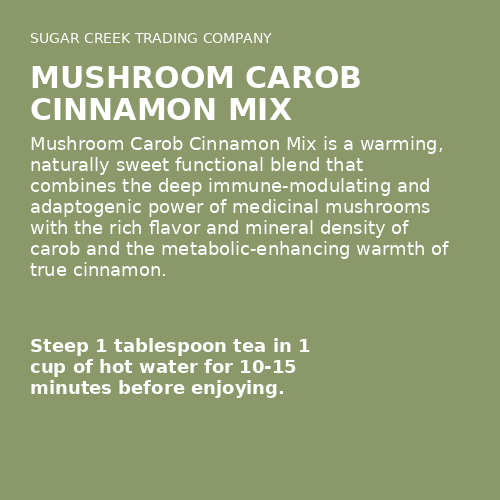
A warming, naturally sweet functional blend that combines the deep immune-modulating and adaptogenic power of medicinal mushrooms with the rich flavor and mineral density of carob and the metabolic-enhancing warmth of true cinnamon.
BOTANICAL IDENTIFICATION
Product Type: Functional mushroom and botanical blend
Common Names: Mushroom carob cinnamon mix, mushroom hot cocoa alternative, functional mushroom latte blend
Category: Adaptogenic and immune-support beverage formula
This blend brings together three distinct categories of health-promoting ingredients. The medicinal mushroom component typically features species such as reishi (Ganoderma lucidum), chaga (Inonotus obliquus), lion's mane (Hericium erinaceus), or cordyceps (Cordyceps militaris), each contributing unique polysaccharides and triterpenes. Carob powder (Ceratonia siliqua), ground from the dried pods of the Mediterranean carob tree, provides a naturally sweet, chocolate-like flavor along with calcium, iron, and soluble fiber. Cinnamon (Cinnamomum verum or Cinnamomum cassia) rounds out the blend with its warming aromatics, blood sugar-balancing cinnamaldehyde, and centuries of use as a digestive and circulatory tonic.
The result is a formula that tastes remarkably like a rich, spiced hot cocoa while delivering a pharmacologically active suite of immune-modulating, adaptogenic, and metabolically supportive compounds.
CULTURAL AND HISTORICAL USE
The practice of combining medicinal mushrooms with warming spices and sweet, nourishing bases has deep roots in multiple healing traditions. In Traditional Chinese Medicine, reishi mushroom (ling zhi) has been revered as the "mushroom of immortality" for over 2,000 years, classified in the Shennong Bencao Jing as a superior-grade herb that calms the spirit, tonifies qi, and supports longevity. TCM practitioners have long incorporated warming spices like cinnamon bark (rou gui) into mushroom formulas to improve circulation, enhance digestive absorption of tonic compounds, and counterbalance the cooling nature of some medicinal fungi. The concept of creating palatable, daily-use tonic beverages from medicinal mushrooms is well-established in Chinese, Japanese, and Korean wellness culture.
In Siberian and Russian folk medicine, chaga mushroom has been consumed as a daily tea since at least the 12th century, valued for its purported ability to ward off illness, improve stamina, and promote general vitality. Finnish and Baltic peoples also maintained long traditions of chaga tea consumption. The addition of warming spices and natural sweeteners to these mushroom preparations made them more palatable for daily use, particularly during harsh northern winters.
Carob has its own ancient pedigree. Native to the eastern Mediterranean, carob pods have been consumed for at least 4,000 years. The ancient Egyptians used carob as a food and medicine, and it is believed to be the "locust" referenced in biblical accounts of John the Baptist's wilderness diet. In traditional Mediterranean herbalism, carob has been used to soothe digestive complaints, particularly diarrhea in children, and as a nutritive food for convalescents. Its naturally sweet, chocolate-like flavor made it a valued ingredient in tonic preparations long before the modern era. Cinnamon was one of the most prized spices of the ancient world, traded along routes connecting Sri Lanka, Egypt, and Rome. It was listed in the Ebers Papyrus (circa 1550 BCE) as a medicinal agent and has been a cornerstone of Ayurvedic, Chinese, and Unani medicine for digestive support, circulatory enhancement, and respiratory health.
KEY BIOACTIVE COMPOUNDS & BENEFITS
| Compound/Class | Source in Blend | Human Benefit | Role in Organism |
|---|---|---|---|
| Beta-glucans (1,3/1,6-beta-D-glucans) | Medicinal mushrooms | Potent immune modulation; activates macrophages, natural killer cells, and dendritic cells | Structural polysaccharide in fungal cell walls |
| Triterpenes (ganoderic acids, betulinic acid) | Reishi, chaga | Anti-inflammatory, hepatoprotective, and adaptogenic activity; supports stress resilience | Chemical defense against pathogens and herbivory |
| Cinnamaldehyde and proanthocyanidins | Cinnamon bark | Supports healthy blood sugar metabolism; antimicrobial; enhances peripheral circulation | Antimicrobial defense compound in bark |
| Condensed tannins (proanthocyanidins) and D-pinitol | Carob powder | Digestive soothing; prebiotic fiber support; mild blood sugar regulation | Tannins deter herbivory; pinitol aids osmotic regulation |
| Melanin complex and superoxide dismutase (SOD) | Chaga mushroom | Exceptional antioxidant capacity; protects DNA and cellular structures from oxidative damage | UV protection and environmental stress adaptation |
What distinguishes this blend is the complementary interplay between its three components. The medicinal mushrooms provide deep immune and adaptogenic activity through their beta-glucans and triterpenes. Cinnamon enhances the bioavailability of these compounds through improved circulatory delivery while contributing its own metabolic benefits. Carob provides the palatable, naturally sweet matrix that makes daily consumption enjoyable, while simultaneously contributing its own prebiotic fiber, minerals, and gentle blood sugar support. The result is a formula where flavor and function are genuinely aligned.
HOW IT WORKS IN THE BODY
This blend exerts its effects through several complementary and synergistic physiological pathways.
Immune Modulation and Defense:
The beta-glucans from medicinal mushrooms are among the most well-studied natural immunomodulators. They bind to Dectin-1 and complement receptor 3 (CR3) on innate immune cells, triggering a cascade that activates macrophages, natural killer (NK) cells, and dendritic cells. Unlike simple immune stimulants, beta-glucans function as biological response modifiers, meaning they upregulate an underactive immune system and help modulate an overactive one. This dual-directional activity, extensively documented in research published in Mediators of Inflammation (Akramiene et al., 2007), makes mushroom beta-glucans uniquely valuable for long-term immune support without the risk of overstimulation.
Adaptogenic Stress Response:
The triterpene compounds from reishi and chaga modulate the hypothalamic-pituitary-adrenal (HPA) axis, helping normalize the cortisol response to physical and psychological stress. Reishi's ganoderic acids have been shown to promote calmness and improve sleep quality without sedation, while chaga's betulinic acid and related compounds support cellular resilience under oxidative stress conditions. This adaptogenic activity helps the body maintain homeostasis under varying demands.
Blood Sugar and Metabolic Support:
Cinnamon's cinnamaldehyde and type-A proanthocyanidins enhance insulin sensitivity by activating insulin receptor signaling pathways and increasing glucose uptake into cells. A meta-analysis published in the Journal of Medicinal Food (Allen et al., 2013) confirmed that cinnamon supplementation significantly reduced fasting blood glucose in subjects with type 2 diabetes. Carob's D-pinitol compound works through a complementary mechanism, acting as an insulin mimetic that facilitates glucose transport. The combination of these two ingredients in a single blend creates a layered approach to healthy post-meal blood sugar management.
Digestive Comfort and Prebiotic Support:
Carob's high soluble fiber content, particularly its galactomannan fraction, acts as a prebiotic substrate for beneficial gut bacteria, supporting the growth of Bifidobacteria and Lactobacillus species. Carob tannins have a gentle astringent effect on the intestinal mucosa, which has been traditionally valued for managing loose stools and soothing digestive discomfort. Cinnamon complements this with its carminative and antimicrobial properties, reducing gas, bloating, and intestinal dysbiosis.
DOSE GUIDELINES
| Preparation Type | Typical Dose | Purpose |
|---|---|---|
| Hot beverage (latte or cocoa style) | 1 to 2 tablespoons blended into 8 to 12 oz hot water or warm milk | Daily immune support, adaptogenic tonic, and metabolic wellness |
| Smoothie addition | 1 to 2 teaspoons blended into smoothie | Convenient daily supplementation with nutritional enhancement |
| Culinary use | 1 to 2 teaspoons added to oatmeal, baking, or energy balls | Incorporating functional mushroom benefits into daily diet |
This blend is designed for consistent, long-term daily use. Medicinal mushroom beta-glucans produce their most significant immunomodulatory effects with sustained intake over weeks to months, as the immune system requires time to respond and adapt to these biological response modifiers. One to two servings daily, consumed as a warm beverage, provides an effective and enjoyable delivery method. Morning use is ideal for those seeking the adaptogenic and energizing benefits, while evening use may be preferable for those prioritizing the calming, sleep-supportive properties of reishi.
PREPARATION AND USES
The most popular and effective preparation is as a warm beverage. Add 1 to 2 tablespoons of the blend to a mug, pour in hot (not boiling) water or warmed milk of choice, and whisk or froth until smooth. The carob provides natural sweetness that often eliminates the need for additional sweetener, though a touch of honey or maple syrup complements the flavor beautifully. For a richer "mushroom hot cocoa" experience, use oat milk or coconut milk and whisk vigorously to create a frothy, creamy texture. A pinch of sea salt enhances the chocolate-like notes of the carob.
This blend is also remarkably versatile in the kitchen. It can be stirred into morning oatmeal or porridge, blended into protein shakes and smoothies, incorporated into raw energy ball recipes, or used as a flavoring in baked goods such as muffins and pancakes. For a concentrated tonic preparation, simmer 2 tablespoons of the blend in 16 ounces of water or milk for 10 to 15 minutes on low heat, strain if desired, and sip throughout the morning. This longer extraction enhances the release of beta-glucans and triterpenes from the mushroom component.
OPTIMAL CONTEXT FOR USE
This blend is especially well-suited for individuals experiencing:
Frequent illness or immune vulnerability who seek a daily, food-based approach to strengthening immune resilience without overstimulating the immune system
Chronic stress and adrenal fatigue patterns where an adaptogenic tonic taken in a comforting, ritual-like beverage form supports both physiology and psychological well-being
Blood sugar management goals where gentle, dietary-level support for healthy glucose metabolism complements standard care and dietary modifications
Caffeine sensitivity or coffee replacement for those seeking a warm, satisfying morning or afternoon beverage that provides sustained energy without caffeine jitters or sleep disruption
Digestive sensitivity where the naturally caffeine-free, low-acid, prebiotic-rich profile is better tolerated than coffee, traditional tea, or conventional hot cocoa
This blend pairs naturally with other wellness practices such as meditation, morning journaling, or gentle movement, and complements additional supplementation with vitamin D, probiotics, and omega-3 fatty acids for comprehensive daily health support.
SUSTAINABILITY AND ETHICAL HARVESTING
The sustainability profile of this blend is generally favorable, with some important considerations. Cultivated medicinal mushrooms (reishi, lion's mane, cordyceps) are grown on organic substrates in controlled environments and represent a highly sustainable form of agriculture with minimal water and land requirements. However, wild-harvested chaga has become a sustainability concern due to explosive demand. Chaga grows slowly on birch trees in boreal forests, and overharvesting has depleted populations in some regions of Russia, Finland, and Canada. Sourcing from suppliers who harvest chaga sustainably, leaving adequate portions of the conk to allow regeneration, is essential.
Carob is a drought-resistant tree that thrives in marginal Mediterranean soils with minimal irrigation, making it an exceptionally sustainable crop. Carob orchards help prevent desertification and provide habitat in arid landscapes. Cinnamon is extensively cultivated in Sri Lanka, Indonesia, and Vietnam; true Ceylon cinnamon (Cinnamomum verum) from Sri Lanka is grown in traditional agroforestry systems that support biodiversity. Supporting suppliers who prioritize organic certification, sustainable wild-harvest protocols for chaga, and fair trade practices for cinnamon farmers helps ensure the long-term viability and ethics of this blend's supply chain.
SAFETY AND CAUTIONS
This blend is generally well-tolerated and suitable for long-term daily use. However, the following considerations apply:
Blood-thinning medications: Reishi mushroom has demonstrated mild antiplatelet activity in research settings. Individuals taking anticoagulant medications (warfarin, heparin) or preparing for surgery should consult their healthcare provider before regular use.
Blood sugar medications: Both cinnamon and certain medicinal mushrooms may have mild blood sugar-lowering effects. Those on insulin or oral hypoglycemic agents should monitor glucose levels and discuss use with their provider.
Autoimmune conditions: Because medicinal mushroom beta-glucans modulate immune function, individuals with autoimmune conditions should consult a healthcare provider before use, as the immune-activating properties could theoretically influence autoimmune activity.
Cassia cinnamon and coumarin: If the blend uses cassia cinnamon (Cinnamomum cassia) rather than Ceylon cinnamon (C. verum), the coumarin content may be a concern at very high daily doses. At typical beverage-level consumption (1 to 2 teaspoons of the whole blend), coumarin exposure remains well within safe limits for most individuals. Those with liver conditions should exercise caution with high-dose cassia cinnamon.
Pregnancy and nursing: While carob and small amounts of cinnamon are considered safe during pregnancy, some medicinal mushrooms (particularly reishi) lack sufficient safety data for use during pregnancy and breastfeeding. Consult a qualified healthcare provider before use during these periods.
REFERENCES
Akramiene, D., et al. "Effects of beta-glucans on the immune system." Medicina (Kaunas), 43(8), 2007, pp. 597-606.
Allen, R. W., et al. "Cinnamon use in type 2 diabetes: an updated systematic review and meta-analysis." Annals of Family Medicine, 11(5), 2013, pp. 452-459.
Glamoclija, J., et al. "Chemical characterization and biological activity of chaga (Inonotus obliquus), a medicinal mushroom." Journal of Ethnopharmacology, 162, 2015, pp. 323-332.
FINAL NOTE
The mushroom carob cinnamon mix represents a thoughtful convergence of ancient tonic traditions and modern functional food science. It transforms the profound but often challenging flavors of medicinal mushrooms into a genuinely delicious daily ritual, one that quietly delivers immune-modulating beta-glucans, stress-buffering adaptogens, and metabolic-balancing botanicals with every warm, satisfying cup. For those seeking to replace caffeine-driven morning habits with something that truly nourishes, this blend offers a deeply rewarding alternative.
Share