Sugar Creek Trading Company
Mushroom Cordyceps
Mushroom Cordyceps
Couldn't load pickup availability
CORDYCEPS MILITARIS
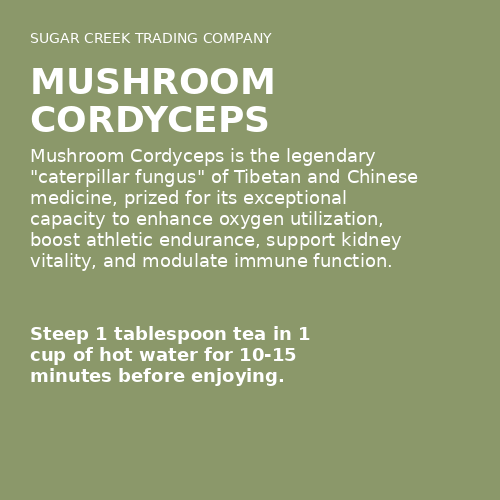
The legendary "caterpillar fungus" of Tibetan and Chinese medicine, prized for its exceptional capacity to enhance oxygen utilization, boost athletic endurance, support kidney vitality, and modulate immune function.
BOTANICAL IDENTIFICATION
Scientific Name: Cordyceps militaris (L.) Fr.
Common Names: Cordyceps, caterpillar mushroom, orange caterpillar fungus, yong chong xia cao (Chinese), dong chong xia cao (for C. sinensis), keeda jadi (Hindi)
Family: Cordycipitaceae (formerly Clavicipitaceae)
Cordyceps militaris is an entomopathogenic fungus, meaning it naturally parasitizes insect larvae and pupae. The fruiting body emerges as a slender, club-shaped structure 2 to 8 centimeters tall, vivid orange to reddish-orange in color, with a finely granular surface created by densely packed perithecia (spore-producing structures) embedded in the upper portion of the stroma. In the wild, the fungus infects buried insect larvae, consuming the host tissue and eventually producing its characteristic bright orange club above the soil surface.
Cordyceps militaris is found across temperate regions of North America, Europe, and Asia, growing in forest soils, grasslands, and leaf litter wherever suitable insect hosts are present. Unlike its rarer and far more expensive relative Cordyceps sinensis (now reclassified as Ophiocordyceps sinensis), which is restricted to high-altitude Tibetan Plateau grasslands, C. militaris has been successfully cultivated on grain-based substrates and nutrient media, making it commercially available at a fraction of the cost while retaining comparable bioactive compound profiles.
CULTURAL AND HISTORICAL USE
The Cordyceps genus occupies a singular position in the history of traditional medicine, representing perhaps the most valued and mythologized medicinal fungus in the world. The earliest written records of Cordyceps use appear in Tibetan medical texts dating to the 15th century, where it was described as a powerful tonic that "increases bodily energy, improves appetite, and treats all manner of illness." Tibetan yak herders reportedly first noticed their animals becoming notably more vigorous after grazing in alpine meadows where the wild fungus grew, leading to human experimentation and centuries of subsequent use.
In Traditional Chinese Medicine, Cordyceps is classified as a premier tonic that simultaneously tonifies both yin and yang, a rare and highly prized quality. It enters the lung and kidney meridians and is prescribed for kidney yang deficiency (fatigue, low libido, weak lower back), lung qi deficiency (chronic cough, shortness of breath, asthma), and as a recovery tonic following serious illness or surgery. The classical TCM text Ben Cao Cong Xin (New Compilation of Materia Medica, 1757) states that Cordyceps "protects the lungs, benefits the kidney, stops blood, resolves phlegm, and checks cough." It was traditionally reserved for the emperor and aristocracy due to its extreme rarity and cost, with wild Tibetan specimens historically worth more per gram than gold.
Cordyceps gained dramatic international attention in 1993, when a group of Chinese women distance runners shattered multiple world records at the Chinese National Games in Beijing. Their coach, Ma Junren, attributed their extraordinary performances in part to a training regimen that included Cordyceps supplementation. While this claim remains debated, it catalyzed a surge of scientific research into the fungus's effects on athletic performance and oxygen metabolism that continues to this day.
KEY BIOACTIVE COMPOUNDS & BENEFITS
| Compound/Class | Location in Fungus | Human Benefit | Role in Fungus |
|---|---|---|---|
| Cordycepin (3'-deoxyadenosine) | Fruiting body and mycelium | Anti-inflammatory, anti-tumor, and anti-fatigue activity; modulates purine metabolism and cellular energy pathways | Nucleoside analogue involved in host insect tissue colonization |
| Adenosine | Fruiting body | Supports cardiovascular function, vasodilation, and smooth muscle relaxation; modulates neurotransmission | Purine nucleoside for cellular signaling and energy transfer |
| Beta-glucans (1,3/1,6-beta-D-glucans) | Cell walls of fruiting body and mycelium | Immune modulation through activation of innate immune cells (macrophages, NK cells, dendritic cells) | Structural polysaccharide in fungal cell wall |
| Cordycepic acid (D-mannitol) | Fruiting body | Mild diuretic; osmotic regulation; supports kidney function and reduces cerebral edema | Osmotic stress protectant and carbon storage |
| Ergosterol (provitamin D2) | Fruiting body and mycelium | Precursor to vitamin D2 upon UV exposure; supports bone health, immune function, and hormonal balance | Cell membrane structural component |
The phytochemical signature of Cordyceps militaris is dominated by cordycepin, a unique nucleoside analogue that is structurally similar to adenosine but lacks a hydroxyl group at the 3' position of its ribose sugar. This subtle structural difference gives cordycepin its remarkable range of biological activities, from anti-inflammatory effects to anti-fatigue and anti-tumor properties. Notably, cultivated C. militaris has been shown in multiple analyses to contain higher concentrations of cordycepin than wild C. sinensis, making the cultivated species an equal or superior source of this key bioactive compound.
HOW IT WORKS IN THE BODY
Cordyceps exerts its effects through several interconnected mechanisms that converge on enhanced cellular energy production, improved oxygen utilization, immune optimization, and endocrine support.
Oxygen Utilization and Athletic Performance:
Cordyceps has been shown to increase the body's production of adenosine triphosphate (ATP), the fundamental unit of cellular energy, by enhancing mitochondrial efficiency. Research published in the Journal of Alternative and Complementary Medicine (Chen et al., 2010) demonstrated that Cordyceps supplementation increased maximal oxygen consumption (VO2 max) in healthy older adults. The adenosine content promotes vasodilation, improving blood flow and oxygen delivery to working muscles and organs. Cordycepin further supports this by modulating the AMPK pathway (adenosine monophosphate-activated protein kinase), a master regulator of cellular energy metabolism that governs glucose uptake, fatty acid oxidation, and mitochondrial biogenesis.
Immune Modulation:
The beta-glucan polysaccharides in Cordyceps activate innate immune cells through Dectin-1 and Toll-like receptor (TLR) pathways, enhancing the body's surveillance and response to pathogens while modulating overactive immune responses. Cordycepin additionally inhibits the NF-kB inflammatory cascade, reducing the production of pro-inflammatory cytokines (TNF-alpha, IL-1beta, IL-6). This dual-directional immunomodulatory activity, stimulating underactive immunity while dampening excessive inflammation, is characteristic of the highest-quality medicinal mushrooms.
Kidney and Adrenal Support:
Cordyceps has demonstrated significant renal protective activity in clinical and experimental studies. Research published in The Journal of Alternative and Complementary Medicine showed that Cordyceps supplementation improved kidney function markers in subjects with chronic kidney disease. The mechanism involves antioxidant protection of renal tubular cells, reduction of fibrotic signaling, and enhancement of renal blood flow through adenosine-mediated vasodilation. This pharmacological evidence directly validates the classical TCM classification of Cordyceps as a kidney tonic.
Endocrine and Reproductive Support:
Multiple studies have demonstrated that Cordyceps supports healthy testosterone production and reproductive function. Cordycepin appears to modulate steroidogenesis in Leydig cells, while the overall adaptogenic effect on the HPA axis helps maintain hormonal balance under stress. Animal studies have shown improvements in sperm quality, libido, and reproductive hormone levels, aligning with the traditional TCM use of Cordyceps to "strengthen the essence" and address kidney yang deficiency.
DOSE GUIDELINES
| Preparation Type | Typical Dose | Purpose |
|---|---|---|
| Dried powder (whole fruiting body) | 1 to 3 grams daily | General tonic, energy support, and immune modulation |
| Hot water extract (concentrated) | 500 mg to 1,000 mg, 2 to 3 times daily | Concentrated immune and performance support |
| Decoction (traditional) | 3 to 6 grams simmered in 2 cups water for 30 to 40 minutes | TCM kidney and lung tonic preparation |
| Tincture (dual extraction) | 2 to 4 mL, 2 to 3 times daily | Broad-spectrum extraction of both water- and alcohol-soluble compounds |
Cordyceps is best used as a daily tonic over extended periods. In TCM, it is traditionally taken for a minimum of 8 to 12 weeks to allow its kidney-tonifying and qi-building effects to accumulate. For athletic performance support, some practitioners recommend beginning supplementation 2 to 3 weeks before important training phases or competition to allow adaptation. Morning or early afternoon dosing is generally preferred, as Cordyceps' energizing effects may interfere with sleep in sensitive individuals if taken late in the day.
PREPARATION AND USES
The simplest and most traditional preparation is a hot water decoction. Simmer 3 to 6 grams of dried whole Cordyceps or powdered fruiting body in water for 30 to 40 minutes, strain, and drink warm. This water extraction effectively liberates the beta-glucan polysaccharides and cordycepic acid. For a more comprehensive extraction that captures both water-soluble polysaccharides and alcohol-soluble cordycepin and triterpenes, a dual extraction (sequential hot water and ethanol extraction) produces the most pharmacologically complete product.
Cordyceps powder blends readily into coffee, tea, smoothies, and warm beverages. Its mild, slightly earthy and nutty flavor integrates well without dominating other ingredients. A popular preparation is "Cordyceps coffee," where 1 to 2 grams of Cordyceps powder is stirred into morning coffee, providing adaptogenic and energizing support that complements caffeine while potentially reducing the jittery side effects. In traditional Chinese cuisine, Cordyceps is simmered into soups and broths, particularly with chicken or duck, creating a deeply nourishing tonic soup traditionally served during winter months or recovery from illness. The dried fruiting bodies can also be encapsulated for those who prefer convenient, measured daily doses.
OPTIMAL CONTEXT FOR USE
This mushroom is especially well-suited for individuals experiencing:
Low energy, chronic fatigue, and reduced stamina where enhanced cellular energy production and oxygen utilization could provide meaningful support
Athletic performance and recovery goals including desire to improve endurance capacity, reduce perceived exertion, and accelerate post-exercise recovery
Respiratory weakness including chronic cough, exercise-induced shortness of breath, or recovery from respiratory illness, where traditional lung-tonifying properties are sought
Kidney health concerns where gentle, long-term renal support complements standard medical care and lifestyle modifications
Age-related vitality decline where maintaining energy, libido, immune resilience, and overall physiological reserve is a priority
Cordyceps combines synergistically with other adaptogenic mushrooms such as reishi (for stress and sleep), lion's mane (for cognitive support), and chaga (for antioxidant protection). It also pairs well with adaptogenic herbs including ashwagandha, rhodiola, and eleuthero for comprehensive adaptogenic support.
SUSTAINABILITY AND ETHICAL HARVESTING
Sustainability is a critical issue in the Cordyceps market. Wild Ophiocordyceps sinensis, the original Tibetan Cordyceps, has been severely overharvested across the Tibetan Plateau due to its extraordinary market value (up to $20,000 per pound for premium specimens). This overharvesting has led to significant population declines, ecosystem disruption in fragile alpine grasslands, and social conflicts in harvesting communities. The IUCN has flagged wild O. sinensis as a species of conservation concern.
Cordyceps militaris, by contrast, is fully cultivable on grain-based substrates (typically rice or wheat) in controlled indoor environments. This cultivation eliminates the need for wild harvesting entirely, produces a consistent and contaminant-free product, and has been demonstrated to yield equal or higher concentrations of cordycepin compared to wild specimens. Choosing cultivated C. militaris is both the more ethical and more pharmacologically reliable option. Sugar Creek Trading Company sources cultivated Cordyceps to ensure both quality and ecological responsibility.
SAFETY AND CAUTIONS
Cordyceps is generally well-tolerated and has a long history of safe use in traditional medicine and modern supplementation.
Autoimmune conditions: Due to its immunomodulatory effects, individuals with autoimmune diseases (lupus, rheumatoid arthritis, multiple sclerosis) should consult their healthcare provider before use, as immune activation could theoretically influence disease activity.
Blood-thinning medications: Cordyceps may have mild anticoagulant properties. Those taking warfarin, heparin, or other anticoagulant medications should consult their provider and monitor coagulation parameters.
Surgery: Discontinue Cordyceps at least two weeks before scheduled surgery due to potential effects on bleeding and blood sugar regulation.
Hypoglycemia risk: Cordyceps may lower blood sugar levels. Individuals taking insulin or oral hypoglycemics should monitor glucose closely and consult their provider.
Pregnancy and nursing: Insufficient safety data exists for Cordyceps use during pregnancy and breastfeeding. Avoidance is generally recommended during these periods unless specifically directed by a qualified practitioner.
REFERENCES
Chen, S., et al. "Effect of Cs-4 (Cordyceps sinensis) on exercise performance in healthy older subjects: a double-blind, placebo-controlled trial." Journal of Alternative and Complementary Medicine, 16(5), 2010, pp. 585-590.
Tuli, H. S., et al. "Pharmacological and therapeutic potential of Cordyceps with special reference to cordycepin." 3 Biotech, 4(1), 2014, pp. 1-12.
Das, G., et al. "Cordyceps spp.: A review on its immune-stimulatory and other biological potentials." Frontiers in Pharmacology, 11, 2021, 602364.
FINAL NOTE
Cordyceps stands at the intersection of ancient Tibetan reverence and cutting-edge sports science, a fungus whose reputation for enhancing human vitality has only grown stronger as modern research validates centuries of empirical observation. The availability of cultivated C. militaris has democratized access to what was once the exclusive tonic of emperors, delivering potent cordycepin and immune-modulating beta-glucans at a sustainable scale. For anyone seeking to deepen their energy reserves, strengthen their respiratory and kidney vitality, or simply build a more resilient body, Cordyceps offers a profoundly effective and time-honored ally.
Share