Sugar Creek Trading Company
Orange Peel
Orange Peel
Couldn't load pickup availability
CITRUS SINENSIS
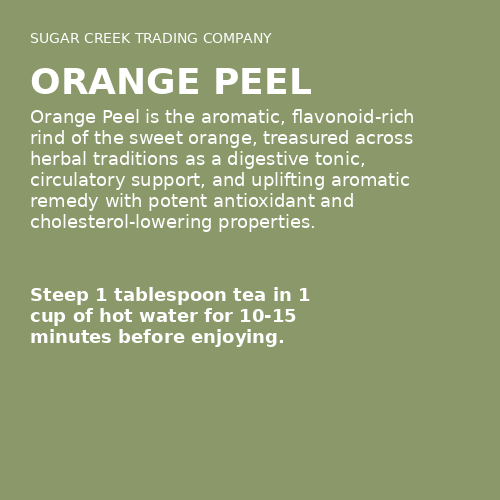
The aromatic, flavonoid-rich rind of the sweet orange, treasured across herbal traditions as a digestive tonic, circulatory support, and uplifting aromatic remedy with potent antioxidant and cholesterol-lowering properties.
BOTANICAL IDENTIFICATION
Scientific Name: Citrus sinensis (L.) Osbeck
Common Names: Orange Peel, Sweet Orange Peel, Orange Zest, Chen Pi (aged tangerine/orange peel in TCM), Narangi (Hindi), Naranja (Spanish), Portokali (Greek)
Family: Rutaceae (Rue/Citrus family)
Citrus sinensis is an evergreen tree growing 5 to 15 meters tall with a rounded crown, glossy dark green ovate leaves, and fragrant white flowers. The fruit is a hesperidium, a modified berry with a leathery rind (pericarp) composed of an outer colored layer (flavedo) rich in essential oil glands and an inner white spongy layer (albedo) dense in flavonoids and pectin. The peel constitutes roughly 25-30% of the total fruit weight and contains a substantially higher concentration of bioactive compounds than the juice or pulp.
Native to southern China and northeastern India, the sweet orange was spread by Arab traders along the Silk Road and throughout the Mediterranean basin, and later carried to the Americas by Spanish and Portuguese explorers in the 15th and 16th centuries. Today it is the most widely cultivated fruit tree in the world, with major production in Brazil, China, India, the United States (Florida, California), Spain, and Mexico.
CULTURAL AND HISTORICAL USE
Orange peel has occupied a distinguished position in Traditional Chinese Medicine for over 2,000 years. Under the name Chen Pi, aged citrus peel is classified as a warm, acrid, and bitter herb that regulates Qi, dries dampness, and transforms phlegm. It is one of the most frequently prescribed herbs in the classical TCM pharmacopoeia, appearing in formulas such as Er Chen Tang (Two-Aged Decoction) for phlegm conditions and Xiang Sha Liu Jun Zi Tang for digestive weakness. In TCM tradition, the value of Chen Pi increases with age, with peels aged 10-30 years commanding premium prices for their mellowed flavor and enhanced therapeutic potency.
In Ayurvedic medicine, orange peel is recognized for its digestive-stimulating, carminative, and phlegm-resolving properties. It is used to kindle agni (digestive fire), reduce ama (metabolic waste), and clear kapha-type congestion. The peel's bitter and pungent qualities make it useful for balancing sluggish digestion and heavy, damp constitutions. In Unani medicine, the Greco-Arab tradition, orange peel is similarly valued as a stomachic and tonic.
European herbalism adopted orange peel following the fruit's introduction to the Mediterranean. It became a staple of apothecary preparations for digestive complaints, nervous tension, and poor appetite. In British and continental herbal traditions, orange peel tinctures and bitters were standard remedies for dyspepsia and flatulence. The peel also found its way into liqueurs, confections, and aromatic preparations, including the famous Earl Grey tea blend and Italian amaro digestif liqueurs. In folk medicine traditions across Latin America, the Caribbean, and Africa, dried orange peel tea is a common household remedy for stomach upset, coughs, and low mood.
KEY BIOACTIVE COMPOUNDS & BENEFITS
| Compound/Class | Location in Plant | Human Benefit | Role in Plant |
|---|---|---|---|
| Hesperidin (flavanone glycoside) | Albedo (white pith) and flavedo | Cholesterol reduction, blood pressure support, vascular integrity, anti-inflammatory activity | UV-protective flavonoid that strengthens cell walls and deters microbial invasion |
| Polymethoxylated flavones (PMFs: nobiletin, tangeretin, sinensetin) | Flavedo (outer colored rind) | Potent anti-inflammatory, anticancer, metabolic syndrome prevention, neuroprotective effects | Lipophilic defense compounds concentrated in the oil gland region of the peel |
| D-Limonene | Essential oil glands in flavedo | Digestive support, heartburn relief, chemopreventive activity, mood elevation | Monoterpene that serves as the primary aromatic insect deterrent and antimicrobial agent |
| Pectin (soluble fiber) | Albedo (white pith) | Cholesterol binding, blood sugar regulation, prebiotic gut support, heavy metal chelation | Structural polysaccharide that maintains cell wall integrity and water retention in fruit tissue |
| Auraptene and other coumarins | Peel and essential oil | Anti-inflammatory, chemopreventive, and neuroprotective properties | Secondary metabolites that protect against UV radiation and pathogen attack |
Orange peel's exceptional therapeutic value lies in its concentration of compounds that are largely absent from the juice. The polymethoxylated flavones, found almost exclusively in citrus peel, have emerged as some of the most pharmacologically active natural compounds studied in recent decades, with research demonstrating effects on cholesterol metabolism, insulin signaling, and inflammatory pathways that rival pharmaceutical agents in potency. Combined with the vascular-protective hesperidin, the digestive and aromatic benefits of D-limonene, and the gut-supporting pectin, orange peel delivers a remarkably complete therapeutic profile from what is too often discarded as waste.
HOW IT WORKS IN THE BODY
Orange peel exerts its effects across multiple physiological systems, with particular strength in cardiovascular, digestive, metabolic, and anti-inflammatory pathways.
Cardiovascular and Cholesterol Metabolism:
Hesperidin and the polymethoxylated flavones (particularly nobiletin and tangeretin) modulate cholesterol metabolism through several mechanisms. PMFs have been shown to inhibit hepatic synthesis and secretion of apolipoprotein B, reducing VLDL and LDL cholesterol levels. Hesperidin improves endothelial function by increasing nitric oxide bioavailability and reduces blood pressure through angiotensin-converting enzyme (ACE) inhibition. Pectin further contributes by binding bile acids in the gut, forcing the liver to draw on circulating cholesterol to produce replacement bile salts. Animal studies have demonstrated cholesterol reductions comparable to statin drugs with PMF supplementation.
Digestive Support and Qi Regulation:
D-limonene stimulates peristalsis, promotes gastric motility, and has demonstrated the ability to dissolve cholesterol gallstones in preliminary studies. It also neutralizes gastric acid on contact, providing symptomatic heartburn relief. The bitter principles in orange peel stimulate the release of digestive enzymes and bile, aligning with its traditional use as a digestive bitter. In TCM terms, orange peel "moves Qi and resolves stagnation," restoring normal flow to a sluggish digestive system.
Anti-Inflammatory and Neuroprotective Pathways:
Nobiletin has attracted significant research interest for its ability to suppress NF-kB-mediated inflammatory cascades, inhibit COX-2 and iNOS expression, and cross the blood-brain barrier to exert neuroprotective effects. Studies have shown nobiletin improves cognitive function in Alzheimer's disease models and protects dopaminergic neurons in Parkinson's disease models. These findings position orange peel as a relevant botanical for neuroprotective support.
Respiratory and Phlegm-Resolving Action:
Orange peel's volatile oils act as mild expectorants, helping to thin mucus and promote expectoration. The warming, drying quality of the peel, recognized in both TCM and Ayurveda, makes it particularly suited for cold, damp respiratory conditions characterized by productive cough and sinus congestion.
DOSE GUIDELINES
| Preparation Type | Typical Dose | Purpose |
|---|---|---|
| Dried peel tea/infusion | 3-9 g steeped in hot water for 10-15 minutes | Digestive support, phlegm resolution, mood uplift |
| Decoction (simmered) | 6-12 g simmered for 15-20 minutes | Stronger digestive and respiratory formula use; traditional Chen Pi preparation |
| Powdered peel | 2-5 g daily, mixed into food, smoothies, or capsules | Cardiovascular support, cholesterol management, daily antioxidant intake |
| Tincture (1:5, 50% ethanol) | 2-4 mL, 2-3 times daily | Concentrated digestive bitter and carminative support |
Orange peel is safe and effective for both acute and long-term use. For digestive complaints, it can be taken as needed before or after meals. For cardiovascular and metabolic benefits, consistent daily use over weeks and months is most effective. In TCM practice, aged orange peel (Chen Pi) is preferred for formulas targeting phlegm and dampness, while fresher peel is used for acute Qi stagnation and digestive discomfort. The dried peel form sold here is versatile for all these applications.
PREPARATION AND USES
Dried orange peel is wonderfully versatile in both the kitchen and the apothecary. For a simple digestive tea, steep a small handful of dried peel pieces in hot water for 10-15 minutes; the resulting brew is aromatic, slightly bitter, and pleasantly warming. For a stronger medicinal decoction, simmer the peel for 15-20 minutes and combine with ginger or cinnamon for enhanced digestive and warming properties. The peel can be ground into powder and added to smoothies, oatmeal, baked goods, spice rubs, and herbal capsule formulations.
In culinary applications, dried orange peel adds depth to stews, grain dishes, marinades, and desserts. It is a traditional ingredient in Chinese five-spice powder, mulled wine, herbal bitters, and numerous spice blends. The peel can be infused into honey or vinegar to create flavored condiments with added therapeutic value. For a traditional Chen Pi preparation, the peel can be aged in a dry, ventilated environment for one to three years, during which its flavor mellows and its therapeutic properties are said to deepen.
OPTIMAL CONTEXT FOR USE
Orange peel is especially well-suited for individuals experiencing:
Digestive sluggishness, bloating, gas, poor appetite, or a feeling of heaviness after meals
Elevated cholesterol or metabolic syndrome risk factors where natural dietary support is desired
Productive coughs, sinus congestion, or excess phlegm, particularly in cold, damp weather or constitutions
Low mood, seasonal dullness, or a desire for a gentle, uplifting aromatic addition to the daily routine
An interest in neuroprotective botanical compounds for long-term cognitive health support
Orange peel combines beautifully with ginger for warming digestive support, with hawthorn berry for cardiovascular synergy, with licorice root for balanced herbal formulas, and with cinnamon and clove for aromatic, warming tea blends. Its bright, familiar flavor makes it one of the most palatable medicinal herbs available.
SUSTAINABILITY AND ETHICAL HARVESTING
Sweet oranges are among the most extensively cultivated fruit crops in the world, with no reliance on wild harvesting and no conservation concerns for the species itself. Dried orange peel represents an especially sustainable product because it transforms a byproduct of the citrus juice industry, material that would otherwise become waste, into a valuable medicinal and culinary ingredient. Using the peel maximizes the value extracted from each fruit and reduces agricultural waste.
Environmental considerations in citrus production include water use in irrigated groves, pesticide application (particularly in conventional production), and the ecological impact of large-scale monoculture. Organically grown orange peel is preferable from both a sustainability and a safety standpoint, as conventional citrus peel can harbor pesticide residues. Sugar Creek Trading Company sources quality dried orange peel with attention to purity and responsible production practices.
SAFETY AND CAUTIONS
Orange peel has an excellent safety record as both a food and a traditional medicine, with thousands of years of documented culinary and therapeutic use across multiple cultures.
Individuals with known citrus allergies should avoid orange peel products. Citrus allergy can manifest as oral itching, skin reactions, or gastrointestinal symptoms.
Orange peel and its constituent compounds (particularly bergamottin and related furanocoumarins, though these are more concentrated in grapefruit) may interact with cytochrome P450 3A4-metabolized medications. Individuals taking statins, calcium channel blockers, or other CYP3A4 substrates should consult a healthcare provider, though sweet orange peel has significantly less interaction potential than grapefruit.
The high pectin content may slow the absorption of certain oral medications if taken simultaneously. Separate orange peel consumption from pharmaceutical medications by at least one hour.
Orange peel is safe during pregnancy at normal culinary and moderate supplemental doses. Its traditional use in Chinese medicine during pregnancy for nausea and digestive support is well established, though very large concentrated doses should be avoided.
REFERENCES
Li, S., Lo, C.Y., & Ho, C.T. "Hydroxylated Polymethoxyflavones and Methylated Flavonoids in Sweet Orange (Citrus sinensis) Peel." Journal of Agricultural and Food Chemistry, 2006; 54(12): 4176-4185.
Mulvihill, E.E., Burke, A.C., & Huff, M.W. "Citrus Flavonoids as Regulators of Lipoprotein Metabolism and Atherosclerosis." Annual Review of Nutrition, 2016; 36: 275-299.
Nakajima, A., & Bharat, B.A. "Nobiletin: A Citrus Flavonoid Possessing Anti-Inflammatory, Anti-Metabolic Syndrome, and Neuroprotective Activities." Current Molecular Pharmacology, 2021.
Benoist, H., & Zhou, T. "Pharmacological Activities of Chen Pi (Citrus reticulata and Its Related Species): A Review." Frontiers in Pharmacology, 2022.
FINAL NOTE
Orange peel is a remarkable example of hidden potency in a familiar form. While the world prizes orange juice, it is the discarded rind that contains the highest concentrations of the fruit's most pharmacologically active compounds, including flavonoids now being studied for their cholesterol-lowering, neuroprotective, and anticancer properties. As a digestive bitter, respiratory aid, cardiovascular tonic, and mood-lifting aromatic, dried orange peel embodies the herbal principle that the most powerful medicines are often the simplest and most accessible.
Share