Sugar Creek Trading Company
Passion Flower
Passion Flower
Couldn't load pickup availability
Passiflora incarnata
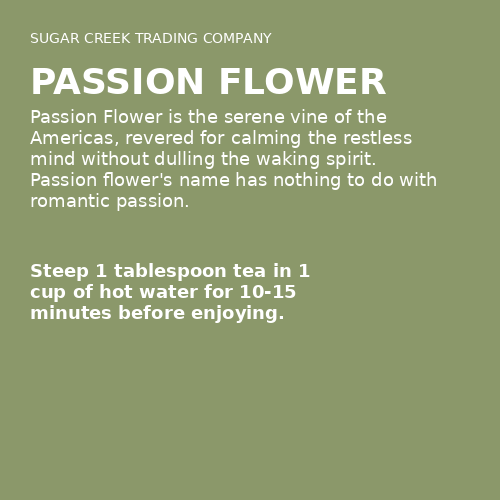
Passion Flower — The serene vine of the Americas, revered for calming the restless mind without dulling the waking spirit.
Botanical Identification
- Species: Passiflora incarnata
- Family: Passifloraceae
- Common Names: Passion Flower, Maypop, Purple Passionflower, Apricot Vine, Wild Passion Vine
- Part Used: Dried aerial parts — leaves, stems, and tendrils; occasionally flowers
- Origin: Native to the southeastern United States, Central America, and South America
- Form: Cut-and-sifted dried herb; a mix of finely cut leaf, stem, and tendril fragments with a distinctive green-to-brown color
Cultural and Historical Use
Passion flower's name has nothing to do with romantic passion. Spanish missionaries in 16th-century South America saw in the plant's extraordinary flower a symbolic representation of the Passion of Christ: the ten petals for the faithful apostles, the corona filaments for the crown of thorns, the five stamens for the five wounds, and the three stigmas for the three nails. They named it "flor de las cinco llagas" — the flower of the five wounds — and carried it back to Europe as both a botanical curiosity and a religious emblem.
Long before European contact, Indigenous peoples of the Americas had established passion flower as a primary medicine. The Cherokee used leaf poultices for bruises and injuries, and drank root infusions as a blood tonic. The Houma of Louisiana applied crushed leaves to boils and wounds. The Algonquin peoples used the root tea for liver conditions. The Aztecs employed Passiflora species as sedatives and analgesics.
Passion flower entered Western clinical herbalism in the mid-19th century when Dr. L. Phares of Mississippi published his observations on its sedative and antispasmodic effects in 1867. By the early 20th century, it was one of the most widely prescribed plant sedatives in both Europe and America. It was listed in the National Formulary of the United States from 1916 to 1936 and remains in the official pharmacopeias of Germany, France, Switzerland, Egypt, and India today.
Key Bioactive Compounds
| Compound | Class | Primary Activity |
|---|---|---|
| Chrysin | Flavone | Anxiolytic via GABA-A receptor modulation; aromatase inhibition |
| Vitexin / Isovitexin | C-glycosyl flavones | Antioxidant, anti-inflammatory, spasmolytic |
| Orientin / Isoorientin | C-glycosyl flavones | Cardioprotective, antioxidant |
| Harmine | Beta-carboline alkaloid | MAO-A inhibition, serotonergic effects (trace amounts in P. incarnata) |
| Harmaline | Beta-carboline alkaloid | Sedative, oneirogenic (dream-enhancing); present in very low concentrations |
| Harmol | Beta-carboline alkaloid | Mild CNS depressant |
| GABA (gamma-aminobutyric acid) | Amino acid neurotransmitter | Directly present in plant tissue; contributes to calming effect |
How It Works in the Body
Passion flower's calming effects arise from a multi-target mechanism that distinguishes it from single-pathway pharmaceutical sedatives. The flavonoid chrysin binds to benzodiazepine sites on GABA-A receptors, enhancing the inhibitory neurotransmitter GABA's natural calming action — a mechanism similar to drugs like diazepam, but far milder and without the dependency risk associated with pharmaceutical benzodiazepines.
Remarkably, Passiflora incarnata also contains free GABA within its tissue. A 2011 study by Appel et al. confirmed that GABA from passion flower extract crosses the intestinal barrier and may contribute directly to the herb's anxiolytic effect, though the extent of its passage across the blood-brain barrier remains under investigation.
The beta-carboline alkaloids (harmine, harmaline, harmol) are present in P. incarnata at trace levels — far below the concentrations found in ayahuasca vine (Banisteriopsis caapi). At these low levels, they contribute mild sedative and possibly dream-enhancing effects without significant MAO inhibition. The C-glycosyl flavones vitexin and isovitexin add spasmolytic (muscle-relaxing) properties, which help explain passion flower's traditional use for menstrual cramps, tension headaches, and muscular spasm.
Clinical trials have compared passion flower favorably to oxazepam for generalized anxiety disorder (Akhondzadeh et al., 2001), with the notable finding that passion flower caused less impairment of job performance. A 2011 double-blind study confirmed that a single dose of passion flower tea significantly reduced anxiety in patients before surgery.
Dose Guidelines
| Use | Amount | Notes |
|---|---|---|
| Tea for mild anxiety / stress | 1-2 teaspoons dried herb per 8 oz boiling water, steep 10-15 min covered | Drink 1-3 cups daily; effects are cumulative over several days |
| Tea for sleep support | 1 tablespoon dried herb per 8 oz water, steep 15-20 min | Drink 30-60 minutes before bed; combine with valerian or lemon balm if desired |
| Strong infusion (acute nervous tension) | 2 tablespoons per 8 oz water, steep 20 min covered | Use as needed during acute stress; not a substitute for crisis support |
| Tincture (1:5, 50% alcohol) | 2-4 mL (40-80 drops), up to 3 times daily | Faster onset than tea; convenient for on-the-go use |
| Bath herb | 1/2 cup dried herb in muslin bag, added to warm bath | Soak 20-30 minutes for whole-body relaxation |
Preparation and Uses
- Simple tea (standard infusion): The most common and effective preparation. Pour boiling water over the dried herb, cover immediately to prevent volatile compound loss, and steep 10-15 minutes. The tea has a mild, slightly grassy flavor with hay-like undertones. It is pleasant enough to drink unsweetened, though honey or lemon improves palatability for some.
- Sleep blend: Combine equal parts passion flower, valerian root, hops strobiles, and lemon balm for a potent but gentle sleep tea. Steep 15 minutes. This synergistic combination is more effective than any single ingredient alone.
- Anxiety support blend: Mix passion flower with skullcap, chamomile, and oat straw for daytime anxiolytic support without excessive drowsiness. Use 1 teaspoon of the blend per cup.
- Glycerite (alcohol-free extract): For those avoiding alcohol, passion flower glycerites are effective. To make at home: fill a jar halfway with dried herb, cover with a mixture of 60% vegetable glycerin and 40% water, steep 4-6 weeks shaking daily, strain. Dose: 2-5 mL up to 3 times daily.
- Smoking blend component: Passion flower leaf is sometimes included in herbal smoking blends for its calming properties. It has a mild, smooth smoke and blends well with mullein, damiana, and skullcap.
- Dream pillow: Stuff a small sachet with dried passion flower, mugwort, and lavender. Place near or inside your pillow to promote vivid, peaceful dreams — a folk practice supported by the herb's mild oneirogenic alkaloids.
Optimal Context for Use
Passion flower excels in the middle ground between everyday stress herbs (like chamomile) and heavy sedatives (like valerian at high doses). It is particularly well-suited for individuals who experience anxiety with mental restlessness — the "racing mind" or "circular thinking" pattern that prevents sleep or productivity. Unlike pharmaceutical anxiolytics, passion flower typically does not impair cognitive function at normal doses, making it appropriate for daytime use by students, professionals, or anyone who needs to stay mentally clear while reducing nervous tension. It is also a top choice for children and the elderly, populations where strong sedatives are inappropriate. For sleep specifically, passion flower works best as part of a blend rather than alone, and its effects become more pronounced with consistent daily use over 1-2 weeks rather than single-dose use.
Sustainability and Ethical Harvesting
Passiflora incarnata is native to the southeastern United States and is not endangered. It grows vigorously as a perennial vine, spreading by underground runners, and is often considered a weed in its native range. Commercial cultivation occurs in the United States, India, Italy, and parts of South America. The plant regenerates readily from rootstock after aerial harvest, making it a sustainable crop when properly managed. Wild harvesting is acceptable in areas where the vine is abundant, but should be done responsibly — never strip a single plant completely, and avoid harvesting from roadsides or sprayed areas. Organically cultivated passion flower is widely available and preferred for medicinal use.
Safety and Cautions
- Sedative medications: Passion flower may enhance the effects of benzodiazepines, barbiturates, and other CNS depressants. Use with caution if taking prescription sedatives, sleep medications, or anti-anxiety drugs. Consult your healthcare provider.
- MAO inhibitors: Although beta-carboline alkaloid levels in P. incarnata are very low, a theoretical interaction exists with MAO-inhibiting drugs. Those taking MAOIs should consult their prescriber before using passion flower.
- Pregnancy and nursing: Traditionally avoided during pregnancy due to potential uterine-stimulating alkaloids. The German Commission E contraindicates passion flower in pregnancy. Small amounts in tea blends are likely low-risk, but medicinal doses should be avoided. Insufficient safety data exists for nursing.
- Surgery: Discontinue use at least 2 weeks before scheduled surgery due to potential interactions with anesthesia and sedative agents.
- Drowsiness: At higher doses or in sensitive individuals, passion flower may cause drowsiness. Exercise caution when driving or operating machinery until you know your response.
- Species identification: Ensure you are using Passiflora incarnata specifically. Other Passiflora species have different safety profiles and some contain significantly higher levels of cyanogenic glycosides.
References
- Akhondzadeh, S., et al. "Passionflower in the treatment of generalized anxiety: a pilot double-blind randomized controlled trial with oxazepam." Journal of Clinical Pharmacy and Therapeutics, 2001; 26(5): 363-367.
- Movafegh, A., et al. "Preoperative oral Passiflora incarnata reduces anxiety in ambulatory surgery patients." Anesthesia and Analgesia, 2008; 106(6): 1728-1732.
- Appel, K., et al. "Modulation of the gamma-aminobutyric acid (GABA) system by Passiflora incarnata L." Phytotherapy Research, 2011; 25(6): 838-843.
- Ngan, A. & Conduit, R. "A double-blind, placebo-controlled investigation of the effects of Passiflora incarnata herbal tea on subjective sleep quality." Phytotherapy Research, 2011; 25(8): 1153-1159.
- Dhawan, K., et al. "Passiflora: a review update." Journal of Ethnopharmacology, 2004; 94(1): 1-23.
- Miroddi, M., et al. "Passiflora incarnata L.: ethnopharmacology, clinical application, safety and evaluation of clinical trials." Journal of Ethnopharmacology, 2013; 150(3): 791-804.
- German Commission E Monograph. "Passiflorae herba (Passion Flower Herb)." Published in Bundesanzeiger, 1990.
This description is provided for educational purposes only. It is not intended to diagnose, treat, cure, or prevent any disease. Consult a qualified healthcare practitioner before using any herb therapeutically, especially if you are pregnant, nursing, or taking medications.
Share