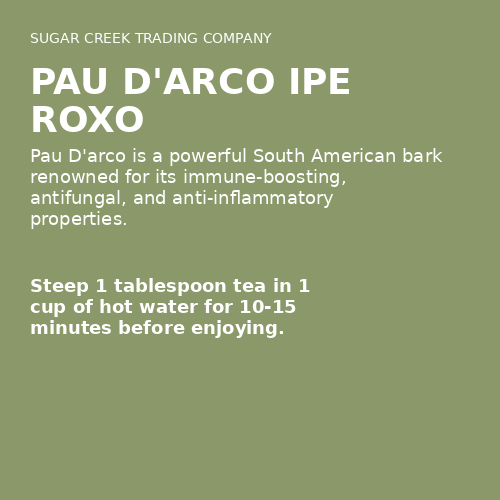
Sugar Creek Trading Company
Pau D'arco Ipe Roxo
Pau D'arco Ipe Roxo
Couldn't load pickup availability
HANDROANTHUS IMPETIGINOSUS var. IPE ROXO
The prized "purple ipe" variety of pau d'arco, sourced from the deep interior of Brazil's Atlantic Forest and cerrado regions, distinguished by its elevated naphthoquinone content, darker bark coloration, and its status as the most sought-after grade in traditional South American herbal medicine.
BOTANICAL IDENTIFICATION
Scientific Name: Handroanthus impetiginosus (Mart. ex DC.) Mattos -- Ipe Roxo selection (syn. Tabebuia avellanedae, Tabebuia impetiginosa var. ipe roxo)
Common Names: Ipe Roxo, Purple Ipe, Red Lapacho, Pau D'arco Roxo, Lapacho Morado, Taheebo Roxo
Family: Bignoniaceae (Trumpet Creeper family)
The ipe roxo ("purple ipe" in Portuguese) refers specifically to the deepest-purple-flowering ecotype of Handroanthus impetiginosus, distinguished from lighter pink-flowering varieties by its darker, more intensely pigmented blossoms and a characteristically reddish-purple to chocolate-brown inner bark. The tree shares the imposing stature of the species as a whole, reaching 25 to 35 meters with a wide-spreading crown, but ipe roxo specimens are noted by Brazilian harvesters for their denser, heavier bark with a distinctly deeper color when freshly cut. This color difference is not merely cosmetic: it reflects a higher concentration of the quinone pigments and phenolic compounds that give the bark its medicinal potency.
Ipe roxo grows primarily in the Atlantic Forest biome, the cerrado savannas, and the transitional forests of southeastern and central Brazil, particularly in the states of Minas Gerais, Sao Paulo, Parana, and Mato Grosso do Sul. It is considered the premium medicinal grade of pau d'arco in Brazilian traditional medicine, and experienced harvester families have passed down knowledge of identifying and selectively harvesting these superior specimens for generations.
CULTURAL AND HISTORICAL USE
Within the broader tradition of pau d'arco use in South America, ipe roxo holds a special status. Brazilian raizeiros (root doctors) and curandeiros (folk healers) have long distinguished between different grades and varieties of lapacho bark, and ipe roxo is consistently regarded as the most medicinally potent. The term "roxo" specifically denotes the purple or dark-red flowering form, and in the herb markets of Belem, Sao Paulo, and Rio de Janeiro, ipe roxo commands a premium price based on generations of empirical observation that it produces stronger decoctions with more reliable therapeutic outcomes.
The Guarani peoples of Paraguay and southern Brazil, whose territory overlaps with the natural range of ipe roxo, used decoctions of this bark specifically for the most serious infections and inflammatory conditions. Their oral traditions describe it as a "blood purifier" and "forest medicine of last resort" -- the bark to turn to when lesser remedies failed. The Callawaya itinerant healers of Bolivia also specifically sought the darkest-barked lapacho trees, demonstrating that the distinction between ordinary pau d'arco and the roxo variety was recognized across widely separated indigenous traditions.
In the modern Brazilian herbal market, ipe roxo became nationally famous during the 1960s and 1970s after reports from the Municipal Hospital of Santo Andre, where Dr. Orlando dei Santi administered lapacho decoctions to patients with various inflammatory and infectious conditions. The bark used in these early reports was specifically identified as ipe roxo. Since then, it has been the subject of intensive phytochemical research at Brazilian universities, with studies consistently confirming that the dark-barked ecotype contains higher concentrations of beta-lapachone and related naphthoquinones than lighter-barked specimens of the same species.
KEY BIOACTIVE COMPOUNDS & BENEFITS
| Compound/Class | Location in Plant | Human Benefit | Role in Plant |
|---|---|---|---|
| Beta-lapachone (elevated concentration in roxo variety) | Inner bark, concentrated at heartwood-cambium interface | Potent antifungal, antibacterial, and anti-tumor activity; NQO1-dependent oxidative stress in abnormal cells | Primary chemical defense compound protecting the heartwood |
| Lapachol | Inner bark | Broad antimicrobial, antiparasitic, and anti-inflammatory activity | Antifungal defense of the cambium zone |
| Dehydro-alpha-lapachone and alpha-lapachone | Inner bark | Complementary antimicrobial and cytotoxic activity; broader naphthoquinone spectrum than standard bark | Secondary quinone defense metabolites |
| Anthocyanins and proanthocyanidins | Inner bark and flowers | Potent antioxidant activity; vascular protection; anti-inflammatory synergy | Responsible for the deep purple pigmentation; UV and oxidative stress defense |
| Iridoid glycosides and condensed tannins | Bark layers | Astringent, wound-healing, and antimicrobial support | Structural defense and tissue repair at bark surfaces |
What distinguishes ipe roxo from standard pau d'arco inner bark at the chemical level is the consistently higher concentration of beta-lapachone and the presence of additional quinone derivatives (alpha-lapachone and dehydro forms) in measurably greater amounts. The deep purple-red coloration of the roxo bark also indicates a richer anthocyanin and proanthocyanidin fraction, which adds a dimension of antioxidant and vascular-protective activity not as pronounced in lighter-barked varieties. This phytochemical richness is why ipe roxo has been the preferred variety in formal research studies and why experienced South American herbalists specifically seek it out.
HOW IT WORKS IN THE BODY
Ipe roxo works through the same core mechanisms as standard pau d'arco bark but with enhanced potency owing to its elevated naphthoquinone and antioxidant content.
Enhanced Antimicrobial Spectrum:
The higher beta-lapachone content in ipe roxo translates to more potent in vitro activity against resistant fungal strains, including fluconazole-resistant Candida species and dermatophytes. Beta-lapachone generates intracellular superoxide radicals within microbial cells through a futile redox cycling mechanism, effectively overwhelming the pathogen's antioxidant defenses. The broader naphthoquinone profile of the roxo variety (including alpha-lapachone and dehydro forms) extends this activity to a wider range of organisms than the lapachol-dominant profile of standard bark.
NQO1-Mediated Cellular Activity:
Beta-lapachone has drawn significant research attention for its interaction with the enzyme NQO1 (NAD(P)H:quinone oxidoreductase 1), which is overexpressed in many types of abnormal cells. NQO1 bioactivates beta-lapachone into a form that triggers catastrophic oxidative stress specifically within cells expressing high levels of this enzyme, while leaving normal cells relatively unaffected. This selectivity is the basis of ongoing pharmaceutical research, though the concentrations achievable through traditional decoction are far lower than those used in laboratory studies.
Antioxidant and Vascular Protection:
The anthocyanins and proanthocyanidins unique to the roxo variety's richer pigment profile provide antioxidant protection that complements the pro-oxidant antimicrobial action of the naphthoquinones. In the body, these polyphenols scavenge free radicals, protect endothelial cell integrity, and reduce inflammatory damage to blood vessel walls. This is an additional therapeutic dimension not present to the same degree in lighter-barked pau d'arco varieties.
Immune Modulation and Inflammation:
Like standard pau d'arco, ipe roxo activates innate immune cells (macrophages and NK cells) while simultaneously inhibiting the COX-2 and NF-kB inflammatory pathways. The stronger naphthoquinone dose delivered per cup of ipe roxo decoction means that therapeutic immune modulation may be achieved at slightly lower volumes of tea, which is relevant for individuals who find larger quantities of bark tea difficult to consume.
DOSE GUIDELINES
| Preparation Type | Typical Dose | Purpose |
|---|---|---|
| Decoction (standard) | 1-2 tablespoons bark simmered in 3-4 cups water for 15-20 minutes; 1-3 cups daily | Immune support, antimicrobial, and anti-inflammatory use |
| Tincture (1:5, 50-60% ethanol) | 1.5-3 mL, two to three times daily | Concentrated extract for acute infections or candida protocols |
| Capsules (powdered ipe roxo bark) | 500-750 mg, two to three times daily | Standardized oral dosing |
| Topical decoction | Double-strength decoction applied externally as wash or compress | Fungal skin infections, wound care, and inflammatory skin conditions |
Because ipe roxo has a higher naphthoquinone concentration than standard pau d'arco inner bark, slightly lower doses may achieve equivalent therapeutic effects. Start with 1 tablespoon per decoction and increase to 2 tablespoons as tolerance is established. As with all pau d'arco preparations, decoction (simmering) is essential -- simply steeping in hot water will not adequately extract the active compounds from the dense bark tissue. For acute immune challenges, a 2- to 3-week course at full dose is traditional, followed by a 1-week rest period before resuming if needed.
PREPARATION AND USES
Ipe roxo bark should be prepared as a decoction for maximum potency. Place 1 to 2 tablespoons of bark in a stainless steel or enamel pot with 3 to 4 cups of cold water, bring to a gentle boil, reduce heat, and simmer with the lid partially on for 15 to 20 minutes. The resulting tea should have a deep reddish-brown color noticeably darker than standard pau d'arco -- this color intensity is one of the visual indicators of the roxo variety's richer chemistry. Strain and drink warm. The flavor is slightly more bitter and tannic than standard pau d'arco, with a distinctive mineral depth. Lemon, raw honey, or a small piece of cinnamon bark can be added to improve palatability.
For tincture preparation, coarsely chop or grind the bark and macerate in 50 to 60% ethanol at a 1:5 ratio for 6 to 8 weeks. The higher alcohol percentage is recommended for ipe roxo to fully extract the elevated beta-lapachone content. Externally, a double-strength decoction (3 tablespoons per 2 cups water, simmered 25 minutes) makes a potent antifungal wash for athlete's foot, ringworm, nail fungus, and skin wounds. Ipe roxo bark can be combined in decoction with cat's claw, uva ursi, or oregano leaf for comprehensive antimicrobial protocols, or with astragalus and reishi for deep immune-building formulas.
OPTIMAL CONTEXT FOR USE
Ipe roxo pau d'arco is especially well-suited for individuals experiencing:
Stubborn or recurrent Candida infections, including oral thrush, vaginal candidiasis, or systemic candida overgrowth that has not responded adequately to standard antifungal approaches or milder pau d'arco preparations
Chronic or recurring infections where a stronger antimicrobial botanical is needed alongside or following conventional treatment, particularly respiratory or urinary tract infections
Inflammatory conditions of the joints, digestive tract, or skin where the combined anti-inflammatory and antimicrobial profile of a more potent pau d'arco variety may provide additional relief
Immune system recovery following prolonged illness, antibiotic courses, or immunosuppressive therapies, where broad-spectrum immune activation is desirable
Individuals who have used standard pau d'arco and are seeking the premium, full-potency grade recognized as the gold standard in Brazilian herbal tradition
Ipe roxo combines powerfully with oregano oil and caprylic acid for aggressive candida protocols, with reishi and turkey tail mushrooms for immune oncology support, and with turmeric and boswellia for anti-inflammatory regimens targeting joint or bowel inflammation.
SUSTAINABILITY AND ETHICAL HARVESTING
The sustainability considerations for ipe roxo are particularly acute because it represents a specific, premium ecotype of an already high-demand species. Ipe roxo trees cannot be cultivated to order -- the deep-purple-barked phenotype occurs naturally within wild populations and requires experienced harvesters to identify correctly. This means that ipe roxo bark is inherently a wild-harvested product, and the distinction between sustainable selective harvest and destructive overharvesting depends entirely on the practices of the harvesting community.
Reputable suppliers source ipe roxo from managed forest concessions in Brazil where harvesting protocols require that bark be taken only from one side of the tree trunk, that no more than a set percentage of trees in any stand be harvested in a given year, and that harvested trees be marked and given multi-year recovery periods. The ipe roxo tree is not currently classified as endangered, but the broader Handroanthus genus faces significant pressure from the timber industry, which values the wood (marketed as "ipe decking") for its extraordinary durability. Supporting suppliers who source bark specifically and sustainably, rather than as a byproduct of logging operations, helps ensure the long-term survival of these medicinally irreplaceable trees.
SAFETY AND CAUTIONS
Ipe roxo shares the safety profile of standard pau d'arco but warrants additional attention due to its higher naphthoquinone concentration:
The elevated beta-lapachone content means that ipe roxo has a narrower margin between therapeutic and excessive doses. Adhere to recommended amounts and do not assume that "more is better." Nausea, digestive discomfort, or loose stools indicate that the dose should be reduced.
Anticoagulant effects are potentially more pronounced with ipe roxo than with standard pau d'arco. Individuals on blood-thinning medications (warfarin, heparin, aspirin, novel oral anticoagulants) must consult their prescribing physician before use. Discontinue at least two weeks prior to any scheduled surgery.
Pregnant and breastfeeding women should not use ipe roxo. Naphthoquinones have shown embryotoxic effects in animal models, and the higher concentrations in this variety increase the margin of concern.
Herxheimer-type reactions (temporary symptom flare-up from microbial die-off) may be more intense with ipe roxo than with standard pau d'arco due to its stronger antimicrobial potency. Begin with half the recommended dose for the first 3 to 5 days and increase gradually.
Extended use beyond 3 weeks at full therapeutic dose should be followed by a rest period of at least 7 days. Continuous high-dose use is not recommended without professional guidance.
REFERENCES
Castellanos, J.R., Prieto, J.M., & Heinrich, M. (2009). "Red Lapacho (Tabebuia impetiginosa) -- a global ethnopharmacological commodity?" Journal of Ethnopharmacology, 121(1), 1-13.
Li, C.J., Li, Y.Z., Pinto, A.V., & Pardee, A.B. (1999). "Potent inhibition of tumor survival in vivo by beta-lapachone plus taxol: combining drugs imposes different artificial checkpoints." Proceedings of the National Academy of Sciences, 96(23), 13369-13374.
Guiraud, P., Steiman, R., Campos-Takaki, G.M., Seigle-Murandi, F., & Simeon de Buochberg, M. (1994). "Comparison of antibacterial and antifungal activities of lapachol and beta-lapachone." Planta Medica, 60(4), 373-374.
Muller, K., Sellmer, A., & Wiegrebe, W. (1999). "Potential antipsoriatic agents: lapacho compounds as potent inhibitors of HaCaT cell growth." Journal of Natural Products, 62(8), 1134-1136.
FINAL NOTE
Ipe roxo represents the pinnacle of the pau d'arco tradition -- the specific variety that Brazilian healers, indigenous curandeiros, and phytochemical researchers all converge upon as the most potent expression of this remarkable tree's medicine. Its darker bark, richer quinone profile, and deeper anthocyanin content make it measurably distinct from standard pau d'arco inner bark, not merely a marketing distinction but a genuine phytochemical difference confirmed by laboratory analysis. For those seeking the strongest traditional-grade lapacho bark available, ipe roxo is the definitive choice.
Share