Sugar Creek Trading Company
Perilla Mint
Perilla Mint
Couldn't load pickup availability
PERILLA FRUTESCENS
The Multifunctional Asian Herb — Culinary, Medicinal, Anti-Inflammatory, and Metabolic Support Agent
BOTANICAL IDENTIFICATION
Scientific Name: Perilla frutescens (L.) Britt.
Common Names: Perilla, Shiso, Beefsteak Plant, Japanese Basil
Family: Lamiaceae
Perilla frutescens is an annual aromatic herb native to East Asia, especially China, Korea, and Japan. It typically grows 0.5–1 meter tall, with square stems and broad, ovate leaves that may be green or purple depending on cultivar. Leaves are softly textured with serrated margins and strong aromatic oils. Small, bell-shaped white to pale lavender flowers form clustered spikes, blooming from late summer into early fall.
Perilla thrives in temperate climates, favoring well-drained soils and sunny to partially shaded environments. The plant grows rapidly and produces both leaf and seed material with distinct medicinal applications.
CULTURAL AND HISTORICAL USE
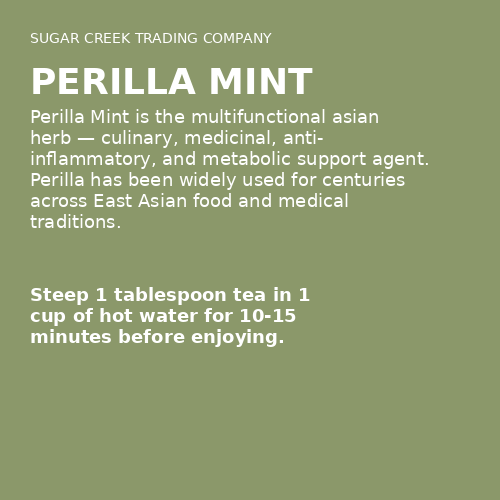
Perilla has been widely used for centuries across East Asian food and medical traditions. In culinary contexts, the leaves are valued for flavor, digestive harmony, and antimicrobial pairing with raw or rich foods. In Traditional Chinese Medicine (TCM), perilla leaf (Zi Su Ye) is used to release exterior wind-cold, ease respiratory congestion, calm nausea, and harmonize digestion. Perilla seed (Zi Su Zi) is used to descend Lung Qi, transform phlegm, and moisten the intestines.
Korean traditional medicine and cuisine place special emphasis on perilla seed oil, used both as a cooking oil and as a tonic for circulation, inflammation, and metabolic balance. Across traditions, perilla has been recognized for anti-inflammatory, anti-allergic, and digestive-regulating properties, with modern research expanding its relevance to cardiometabolic and glycemic health.
KEY BIOACTIVE COMPOUNDS & BENEFITS
| Compound/Class | Location in Plant | Human Benefit | Role in Plant |
|---|---|---|---|
| Perillaldehyde | Leaves | Anti-inflammatory, antimicrobial | Herbivore deterrent, aromatic oil |
| Rosmarinic acid | Leaves, stems | Antioxidant, anti-allergic, insulin-sensitizing | UV and oxidative protection |
| Luteolin | Leaves | Anti-inflammatory, neuroprotective, glucose-regulating | Defense against pathogens |
| Alpha-linolenic acid | Seeds | Omega-3 fatty acid; improves insulin sensitivity and lipid metabolism | Seed energy storage |
Perilla’s phytochemical profile supports not only respiratory and immune health, but also metabolic regulation, particularly through inflammation reduction and lipid–glucose signaling pathways.
HOW IT WORKS IN THE BODY
Perilla exerts its effects through multi-system regulatory mechanisms rather than acute pharmacological force.
Inflammation and Immune Modulation:
Perillaldehyde, rosmarinic acid, and luteolin suppress pro-inflammatory cytokines (including TNF-α and IL-6), helping reduce allergic reactivity and chronic low-grade inflammation.
Metabolic and Glycemic Regulation:
Chronic inflammation is a known driver of insulin resistance. By lowering inflammatory signaling, perilla polyphenols improve insulin receptor sensitivity in peripheral tissues. Additionally, luteolin and rosmarinic acid have demonstrated modulatory effects on glucose metabolism, including mild inhibition of carbohydrate-digesting enzymes and support of insulin signaling pathways.
Lipid and Cardiovascular Support:
Alpha-linolenic acid (ALA) from perilla seeds improves lipid profiles, supports hepatic fat metabolism, and enhances insulin sensitivity through PPAR-mediated pathways. This contributes to improved glycemic control in metabolic syndrome and type 2 diabetes patterns.
Neurological and Antioxidant Effects:
Luteolin’s antioxidant activity supports neuronal protection, while overall oxidative stress reduction further improves metabolic efficiency.
DOSE GUIDELINES
| Preparation Type | Typical Dose | Purpose |
|---|---|---|
| Leaf infusion | 2–4 g dried leaves per cup, steep 10 min | Respiratory relief, anti-inflammatory, metabolic support |
| Seed oil | 1–2 teaspoons daily | Cardiovascular and insulin sensitivity support |
| Powdered leaves | 300–600 mg capsule daily | Antioxidant, allergy, and glycemic regulation adjunct |
Perilla works best as a long-term dietary or tonic herb, rather than as an acute glucose-lowering agent.
PREPARATION AND USES
Traditional preparations include fresh or dried leaf infusions for coughs, digestive discomfort, and allergies, as well as seed oil used both culinarily and medicinally. Perilla leaves are incorporated into salads, soups, fermented dishes, and pickles, supporting digestion and metabolic balance when consumed with meals.
Modern extracts and seed oils are increasingly used as adjuncts in inflammatory and metabolic conditions, including insulin resistance and dyslipidemia.
OPTIMAL CONTEXT FOR USE
Perilla is especially well-suited for individuals experiencing:
-
Seasonal or chronic allergies with inflammatory patterns
-
Respiratory congestion linked to immune reactivity
-
Type 2 diabetes or prediabetes associated with inflammation
-
Metabolic syndrome and dyslipidemia
-
Diet-related digestive sluggishness
It is most effective when combined with dietary improvements and complementary insulin-sensitizing foods or herbs.
SUSTAINABILITY AND ETHICAL HARVESTING
Perilla is widely cultivated and fast-growing, with minimal environmental impact. Sustainable practices include seed saving, avoidance of excessive pesticide use, and preservation of regional cultivars that support traditional food systems.
SAFETY AND CAUTIONS
Perilla is generally regarded as safe when used as food or medicine.
-
Rare allergic reactions have been reported
-
Avoid use in individuals with known Lamiaceae sensitivity
-
Perilla seed oil should be used cautiously in bleeding disorders due to omega-3 content
-
No significant drug interactions are reported at typical dietary or herbal doses
REFERENCES
-
Lee, Y. et al. (2010). Phytochemistry and bioactivity of Perilla frutescens. Journal of Medicinal Plants Research
-
Chen, J. et al. (2015). Anti-inflammatory effects of perillaldehyde in asthma models. Phytomedicine
-
KFDA Herbal Pharmacopoeia (2017). Perilla frutescens Monograph
FINAL NOTE
Perilla frutescens is a bridge herb—linking food and medicine, immunity and metabolism, tradition and modern science. Beyond its culinary charm and anti-allergic reputation, it offers meaningful support for metabolic balance and insulin sensitivity, particularly where inflammation underlies dysregulation.
Its strength lies not in forcing glucose down, but in restoring the conditions under which metabolism can regulate itself, making perilla a valuable ally in both preventive and integrative metabolic care.
Share