Sugar Creek Trading Company
Pleurisy Root
Pleurisy Root
Couldn't load pickup availability
Asclepias tuberosa — Pleurisy Root
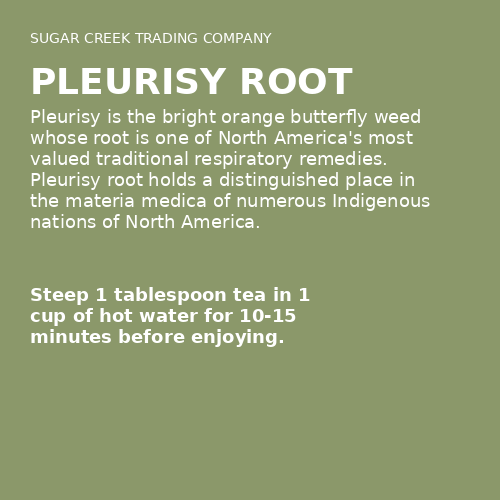
The bright orange butterfly weed whose root is one of North America's most valued traditional respiratory remedies.
Botanical Identification
Species: Asclepias tuberosa L.
Family: Apocynaceae (formerly Asclepiadaceae)
Common Names: Pleurisy Root, Butterfly Weed, Orange Milkweed, Chigger Flower, Flux Root, Wind Root
Parts Used: Dried root
Native Range: Eastern and central North America, from southern Ontario to Florida and west to Arizona
Botanical Description: An upright perennial growing 1–3 feet tall with alternate, lance-shaped leaves and dense, flat-topped clusters of vivid orange to yellow-orange flowers that bloom from June through September. Unlike most milkweeds, A. tuberosa does not produce copious milky latex — its sap is largely clear and watery. The root is a thick, fleshy, spindle-shaped taproot with a tough, yellowish-brown exterior and pale interior. It is this root, carefully dried, that constitutes the herbal product.
Critical Distinction: Asclepias tuberosa must not be confused with common milkweed (Asclepias syriaca) or other Asclepias species that contain higher concentrations of cardiac glycosides (cardenolides). While all Asclepias species contain some cardenolides, A. tuberosa has significantly lower levels and a long history of safe traditional use at appropriate doses. This is the only Asclepias species widely used in herbal medicine.
Cultural and Historical Use
Pleurisy root holds a distinguished place in the materia medica of numerous Indigenous nations of North America. The Cherokee, Natchez, Omaha, Menominee, and Delaware peoples all documented uses of the root for respiratory complaints, fevers, and digestive disturbances. Cherokee healers prepared root decoctions for pleurisy, pneumonia, and other chest ailments — the very use that gave the plant its common English name.
European colonists adopted the remedy enthusiastically. By the 18th century, pleurisy root was a standard item in American domestic medicine chests. The Eclectic physicians of the 19th and early 20th centuries considered it one of the finest diaphoretic and expectorant herbs available. Finley Ellingwood, John King, and Harvey Wickes Felter all wrote extensively about its utility in pleurisy, bronchitis, and febrile respiratory illness. The root was official in the United States Pharmacopeia from 1820 to 1905.
Its common name "butterfly weed" refers to its critical role as a nectar source and larval host plant for monarch butterflies and other pollinators — an ecological function that must be considered when sourcing this herb.
Key Bioactive Compounds
| Compound Class | Key Representatives | Noted Activity |
|---|---|---|
| Cardenolides (cardiac glycosides) | Asclepiadin, uzarigenin derivatives | Expectorant; emetic at high doses (present in lower amounts than other Asclepias spp.) |
| Flavonoids | Rutin, quercetin, kaempferol glycosides | Anti-inflammatory, antioxidant |
| Triterpene saponins | Various steroidal saponins | Expectorant action, surfactant effects on bronchial mucus |
| Amino acids | Free amino acid profile | Nutritive contribution |
| Volatile oils | Minor volatile fraction | Mild antispasmodic |
| Resins and bitter principles | Complex resinous fraction | Digestive stimulant, mild laxative |
How It Works in the Body
Pleurisy root acts primarily as a relaxing expectorant and mild diaphoretic. The saponin and cardenolide fractions stimulate bronchial secretion through a reflex mechanism: mild irritation of the gastric mucosa triggers a vagal reflex that increases fluid output from bronchial glands, effectively thinning and loosening tenacious respiratory mucus. This makes coughs more productive and helps clear congested airways.
The diaphoretic action — promoting gentle perspiration — is particularly valued in febrile conditions. Eclectic physicians described pleurisy root as a "relaxing diaphoretic," meaning it opens the pores and supports the body's natural fever management without the intense heat-driving action of stimulating diaphoretics like cayenne. This cooling, outward-moving action aligns with its traditional use in hot, dry, inflammatory respiratory conditions.
The flavonoid content contributes anti-inflammatory activity that may help reduce the inflammation of pleural and bronchial tissues. The bitter resinous fraction provides mild digestive stimulation and has a gentle laxative effect at higher doses.
The cardenolide content, while significantly lower than in A. syriaca or A. curassavica, still demands respect for dosing boundaries. At therapeutic doses, these compounds contribute to the expectorant reflex. At excessive doses, they can cause nausea, vomiting, and cardiac disturbance.
Dose Guidelines
| Preparation | Amount | Frequency | Notes |
|---|---|---|---|
| Dried root decoction | 1–3 grams simmered in 8 oz water for 15–20 min | 3 times daily | Traditional primary preparation; strain well |
| Tincture (1:5, 60% ethanol) | 1–3 mL | 3 times daily | Start at lower end; increase gradually |
| Powdered root in capsules | 300–500 mg | 3 times daily | Less flexible dosing than decoction or tincture |
| Cold infusion | 1–2 grams in cold water, steep 4–8 hours | 2–3 times daily | Milder extraction; reduces gastrointestinal irritation |
Preparation and Uses
- Root Decoction: The traditional and preferred preparation. Add 1–3 grams of dried, cut root to 8–10 ounces of cold water. Bring to a gentle simmer, cover, and maintain for 15–20 minutes. Strain thoroughly. Drink warm for respiratory congestion and febrile conditions.
- Tincture: A 1:5 tincture in 60% ethanol captures both water-soluble and resin-soluble constituents. Take 1–3 mL in a small amount of water, three times daily. Useful when a decoction is inconvenient.
- Respiratory Blend: Combines well with elecampane root, mullein leaf, and wild cherry bark for productive cough support. Blend with elderflower and yarrow for diaphoretic fever management.
- Chest Compress: A strong decoction can be used to soak a cloth for application as a warm compress over the chest during acute respiratory discomfort.
Optimal Context for Use
- Dry, tight, unproductive coughs where mucus needs to be loosened and expelled
- Febrile respiratory illness with pleuritic pain or chest tightness
- Bronchitis and upper respiratory infections with thick, tenacious mucus
- As a gentle diaphoretic during the early stages of colds and fevers
- Best suited for hot, dry, inflammatory respiratory presentations — less appropriate for cold, wet, boggy conditions
- Pairs well with mullein leaf (demulcent), elecampane (deeper expectorant), and elderflower (synergistic diaphoretic)
Sustainability and Ethical Harvesting
Asclepias tuberosa is a slow-growing perennial with a deep taproot that does not transplant easily and takes several years to reach harvestable size from seed. Wild populations have declined in many areas due to habitat loss, herbicide use, and overharvesting. The plant is listed as a species of concern in several northeastern states and is legally protected in New Hampshire and Maine.
Ethical sourcing is paramount. Cultivated sources should be strongly preferred over wild-harvested root. If wild-harvesting, never take more than 10% of a local population, and never harvest from small or isolated stands. The plant's critical importance to monarch butterfly populations adds ecological urgency to sustainable sourcing. We encourage growers and customers to plant A. tuberosa in pollinator gardens to support both butterfly habitat and future herbal harvests.
Safety and Cautions
- Do not exceed recommended doses. The cardenolide content, while lower than other Asclepias species, can cause nausea, vomiting, diarrhea, and potentially cardiac effects at excessive doses.
- Contraindicated in pregnancy. Pleurisy root has historical reports of uterine stimulant activity and should be avoided during pregnancy.
- Use caution with cardiac medications. The cardenolide content may theoretically interact with digoxin, beta-blockers, calcium channel blockers, and other cardiac drugs. Consult a healthcare provider before combining.
- Not recommended for children under 12 without professional guidance.
- Do not confuse with other Asclepias species. Common milkweed (A. syriaca), tropical milkweed (A. curassavica), and other species contain significantly higher cardenolide levels and are not appropriate for internal herbal use.
- Discontinue use if nausea, vomiting, or heart palpitations occur.
- Fresh root is more emetic than dried root; always use properly dried material for internal preparations.
References
- Felter, H.W. & Lloyd, J.U. (1898). King's American Dispensatory. 18th ed. Ohio Valley Co.
- Ellingwood, F. (1919). American Materia Medica, Therapeutics and Pharmacognosy. Ellingwood's Therapeutist.
- Moerman, D.E. (1998). Native American Ethnobotany. Timber Press.
- Hoffmann, D. (2003). Medical Herbalism: The Science and Practice of Herbal Medicine. Healing Arts Press.
- Malcolm, S.B. & Zalucki, M.P. (1996). "Milkweed latex and cardenolide induction may resolve the lethal plant defence paradox." Entomologia Experimentalis et Applicata, 80(1), 193–196.
- United States Pharmacopeia. (1820–1905). Official monograph entries for Asclepias tuberosa.
Final Note
This product is sold as a botanical specimen and herbal tea ingredient. It is not intended to diagnose, treat, cure, or prevent any disease. The information provided is for educational purposes and reflects traditional use and published research. Consult a qualified healthcare provider before using any herbal product, especially if you are pregnant, nursing, taking medication, or managing a health condition.
Share