Sugar Creek Trading Company
Red Raspberry Leaf
Red Raspberry Leaf
Couldn't load pickup availability
Rubus idaeus
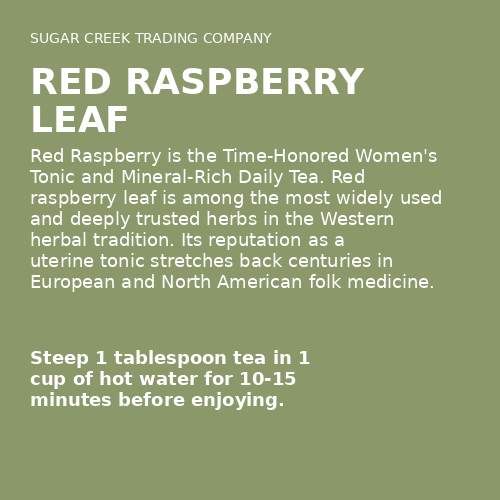
Red Raspberry Leaf — The Time-Honored Women's Tonic and Mineral-Rich Daily Tea
Botanical Identification
Latin Name: Rubus idaeus
Common Names: Red Raspberry Leaf, Raspberry Leaf, European Red Raspberry, Hindberry
Family: Rosaceae (Rose family)
Part Used: Dried leaves
Origin: Native to Europe and northern Asia; widely cultivated and naturalized throughout North America
Description: The leaves of Rubus idaeus are pinnately compound, typically with three to five ovate, serrated leaflets. The upper surface is dark green, while the underside is covered with fine, silvery-white hairs that give it a distinctive pale appearance. When properly dried, the leaves retain their green color and produce a pleasant, mildly astringent tea with subtle fruity undertones. This is the same species commonly sold as "Raspberry Leaf" — the "red" designation refers to the fruit color of the parent plant, distinguishing it from black raspberry (Rubus occidentalis), though in commerce "Raspberry Leaf" and "Red Raspberry Leaf" are used interchangeably for Rubus idaeus.
Cultural and Historical Use
Red raspberry leaf is among the most widely used and deeply trusted herbs in the Western herbal tradition. Its reputation as a uterine tonic stretches back centuries in European and North American folk medicine. Midwives across Britain, Ireland, and Appalachia have recommended raspberry leaf tea to expectant mothers for generations, a practice so pervasive that it persists robustly in modern integrative healthcare.
Beyond its association with pregnancy, raspberry leaf was used historically as a general astringent remedy. European herbalists employed it for diarrhea, sore throats, and mouth ulcers. The Ojibwe, Cherokee, and Iroquois peoples all used Rubus species leaves for digestive complaints and as a general tonic. In the Thomsonian and Eclectic medical traditions of 19th-century America, raspberry leaf appeared frequently in formulas for uterine health, menstrual irregularity, and childhood diarrhea.
In modern herbalism, red raspberry leaf has become one of the most commonly recommended daily teas — valued not only for reproductive health but as a mineral-rich, caffeine-free beverage suitable for all ages and genders. Its mild, pleasant flavor and excellent safety profile have made it a staple in virtually every herbalist's dispensary.
Key Bioactive Compounds
| Compound Class | Key Constituents | Primary Activity |
|---|---|---|
| Tannins | Ellagitannins (including sanguiin H-6), gallotannins | Astringent; tissue toning; antioxidant |
| Flavonoids | Quercetin, kaempferol, tiliroside | Anti-inflammatory; antispasmodic |
| Ellagic Acid | Free ellagic acid and conjugates | Antioxidant; cellular protection |
| Minerals | Iron, calcium, magnesium, manganese, potassium, phosphorus, zinc | Nutritive; supports muscle function and bone health |
| Vitamins | Vitamin C, B-complex vitamins, vitamin E | Immune support; antioxidant |
| Fragarine (alkaloid fragment) | A smooth-muscle active principle identified in early research | Uterine muscle toning; may coordinate contractions |
| Organic Acids | Citric acid, malic acid | Mineral absorption enhancement; mild diuretic |
How It Works in the Body
The therapeutic profile of red raspberry leaf rests on two main pillars: its astringent-toning action and its exceptional mineral density.
The tannins — particularly the ellagitannins — act as gentle tissue tonifiers. When consumed regularly, they tone mucous membranes and smooth muscle tissue throughout the body. This astringent action is the basis for the herb's traditional use in firming and toning the uterine wall. The compound historically called "fragarine" appears to have a specific relaxant effect on uterine smooth muscle in vitro, which may help coordinate, rather than strengthen, muscular contractions during labor.
The mineral profile of raspberry leaf is among the richest of any common herb. It provides bioavailable iron, calcium, and magnesium in a food-like matrix, making it an excellent daily source of these nutrients. The organic acids present in the leaf enhance mineral absorption in the gut. This mineral richness is why herbalists recommend raspberry leaf not only for pregnant women but for anyone seeking a nutritive daily tea.
The flavonoids contribute mild anti-inflammatory and antispasmodic activity, while ellagic acid provides significant antioxidant protection. Together, these compounds make raspberry leaf a comprehensive, gentle, daily-use herb that supports multiple body systems simultaneously.
Dose Guidelines
| Preparation | Amount | Frequency |
|---|---|---|
| Standard tea (infusion) | 1–2 teaspoons per cup, steeped 10–15 minutes | 1–3 times daily |
| Nourishing herbal infusion | 1 ounce (28 g) per quart boiling water, steeped 4–8 hours | 1–3 cups daily |
| Tincture (1:5, 25–40% alcohol) | 2–5 mL | 3 times daily |
| Powdered leaf in capsules | 500–1,200 mg | 2–3 times daily |
| Pregnancy use (third trimester, with midwife guidance) | 1–3 cups of standard infusion daily | Beginning around week 32–34 |
Preparation and Uses
- Daily Mineral Tea: Red raspberry leaf makes a pleasant, mildly astringent tea with subtle fruity-herbal notes. It is one of the few medicinal herbs that people genuinely enjoy drinking on its own, hot or iced.
- Long Infusion: For maximum mineral extraction, prepare a nourishing infusion by steeping 1 ounce of dried leaf in a quart of boiling water for 4 to 8 hours. The resulting deep-green liquid is rich in bioavailable iron and calcium.
- Pregnancy Tea Blends: Classically combined with nettle leaf, oat straw, and alfalfa for a comprehensive prenatal nutritive formula. Always under the guidance of a qualified midwife or healthcare provider.
- Digestive Astringent: A strong infusion can be used as a gentle remedy for loose stools and mild intestinal upset.
- Mouthwash and Gargle: A cooled strong infusion makes an excellent astringent gargle for sore throats and mouth irritations.
- Blending: Pairs beautifully with peppermint, lemon balm, hibiscus, nettle, and rose hips for flavorful herbal tea blends.
Optimal Context for Use
- Daily nutritive tea for all ages and genders seeking mineral-rich hydration
- Uterine toning and preparation for labor (third trimester, with qualified guidance)
- Menstrual cycle support for heavy flow or cramping
- Postpartum recovery and tissue healing
- Mild diarrhea and digestive upset in adults and children
- As a base tea in herbal blends due to its pleasant flavor and nutritive value
- General connective tissue and vascular tone support
Sustainability and Ethical Harvesting
Rubus idaeus is widely cultivated for its fruit, and the leaves are a natural byproduct of commercial raspberry agriculture. The plant grows vigorously and spreads readily via root suckers, making it one of the most sustainable herbs available. Wild raspberry grows abundantly in forest clearings, hedgerows, and disturbed ground throughout the Northern Hemisphere. There are no conservation concerns associated with raspberry leaf harvesting. Our supply is sourced from organically managed farms where leaves are hand-harvested and shade-dried to preserve their green color and full phytochemical content.
Safety and Cautions
- Pregnancy — First Trimester: Some practitioners advise avoiding red raspberry leaf during the first trimester due to its uterine-stimulating reputation, though evidence for harm is minimal. Most midwives recommend beginning use in the second or third trimester. Always consult a qualified midwife or obstetrician.
- Iron Absorption: The tannins in raspberry leaf can inhibit non-heme iron absorption if consumed alongside iron-rich meals. If using for iron supplementation, consume between meals for best absorption of the leaf's own iron content.
- Constipation: In rare cases, the astringent tannins may be mildly constipating if consumed in large quantities. Ensure adequate hydration.
- Drug Interactions: Generally minimal. However, the astringent nature may theoretically reduce absorption of some medications. Separate dosing by at least one hour if taking pharmaceutical drugs.
- General Safety: Red raspberry leaf has an outstanding safety profile and is considered one of the safest herbs in the Western materia medica. It is appropriate for daily, long-term use by most individuals.
References
- Simpson, M., et al. (2001). "Raspberry leaf in pregnancy: its safety and efficacy in labor." Journal of Midwifery & Women's Health, 46(2), 51-59.
- Parsons, M., et al. (1999). "Raspberry leaf and its effect on labour: safety and efficacy." Australian College of Midwives Journal, 12(3), 20-25.
- Hoffman, D. (2003). Medical Herbalism: The Science and Practice of Herbal Medicine. Healing Arts Press.
- Weed, S.S. (1986). Wise Woman Herbal for the Childbearing Year. Ash Tree Publishing.
- Patel, A.V., et al. (2004). "Therapeutic constituents and actions of Rubus species." Current Medicinal Chemistry, 11(11), 1501-1512.
- European Medicines Agency. (2014). "Assessment report on Rubi idaei folium." EMA/HMPC/342424/2013.
Final Note
Red Raspberry Leaf stands as one of the most universally recommended herbs in Western herbalism — and for good reason. Its combination of exceptional mineral content, gentle astringent action, proven safety, and genuinely pleasant taste makes it a rare herb that serves equally well as daily nourishment and targeted therapeutic support. Whether you are seeking a mineral-rich daily beverage, preparing for childbirth under qualified guidance, or simply looking for a caffeine-free tea that tastes good and does your body good, red raspberry leaf delivers quietly and reliably. It is the kind of herb that earns its reputation not through dramatic effects but through steady, cumulative benefit over weeks and months of faithful use.
This information is for educational purposes only and is not intended to diagnose, treat, cure, or prevent any disease. Always consult a qualified healthcare professional before beginning any herbal regimen.
Share