Sugar Creek Trading Company
Red Sandalwood
Red Sandalwood
Couldn't load pickup availability
Pterocarpus santalinus
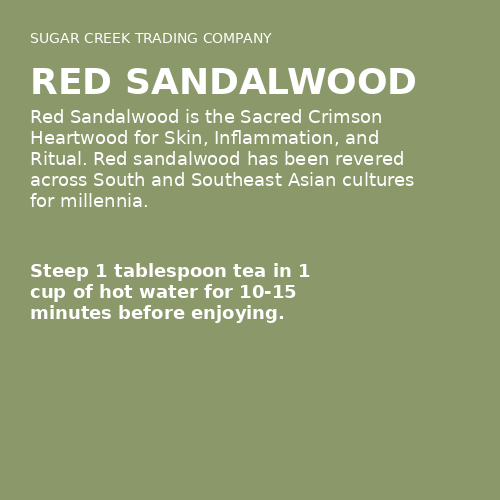
Red Sandalwood — The Sacred Crimson Heartwood for Skin, Inflammation, and Ritual
Botanical Identification
Latin Name: Pterocarpus santalinus
Common Names: Red Sandalwood, Red Sanders, Rakta Chandan, Saunderswood, Lal Chandan
Family: Fabaceae (Legume family)
Part Used: Heartwood (dried, cut, or powdered)
Origin: Endemic to the southern Eastern Ghats of India, primarily Andhra Pradesh
Description: Pterocarpus santalinus is a slow-growing deciduous tree reaching 25 to 30 feet at maturity. The heartwood is a distinctive deep crimson-red to purplish-brown, dense, and finely grained, yielding a rich red powder when ground. This tree is not related to true sandalwood (Santalum album), despite the shared common name. True sandalwood belongs to the family Santalaceae and is valued for its aromatic oil, while red sandalwood belongs to the legume family and is valued for its pigment, astringency, and medicinal heartwood compounds. Red sandalwood has little to no fragrance. The two should never be confused or substituted for one another.
Cultural and Historical Use
Red sandalwood has been revered across South and Southeast Asian cultures for millennia. In Ayurvedic medicine, it is known as Rakta Chandan and classified as a cooling, Pitta-pacifying remedy used extensively for inflammatory skin conditions, fever, and headache. Ayurvedic texts including the Charaka Samhita and Sushruta Samhita describe its application as a paste for skin diseases, burning sensations, and wound healing.
In traditional Chinese medicine, red sandalwood (Zi Tan) has been used to promote blood circulation and relieve blood stasis. It appears in classical formulas for pain associated with stagnant blood and for topical application to skin conditions.
Beyond medicine, red sandalwood holds deep spiritual significance in Hindu and Buddhist traditions. The wood is carved into prayer beads (mala), sacred images, and ritual implements. Its rich red dye has been used for centuries in textile production, cosmetics, and religious body markings. In Japan, powdered red sandalwood has been used in traditional incense blending.
Historically, red sandalwood was one of the most traded luxury woods in the Indian Ocean trade network, and its desirability led to severe overexploitation — a situation that continues to have conservation consequences today.
Key Bioactive Compounds
| Compound Class | Key Constituents | Primary Activity |
|---|---|---|
| Pterostilbene | Pterostilbene (a dimethylated analog of resveratrol) | Potent antioxidant; anti-inflammatory; neuroprotective |
| Santalins (Pigments) | Santalin A, santalin B | Natural dye; antioxidant; photoprotective |
| Flavonoids | Liquiritigenin, isoliquiritigenin, savinin | Anti-inflammatory; estrogenic modulation |
| Isoflavonoids | Homopterocarpin, pterocarpol, pterocarpin | Antimicrobial; anti-inflammatory; hepatoprotective |
| Tannins | Condensed tannins (proanthocyanidins) | Astringent; wound healing; hemostatic |
| Triterpenes | Lupeol, beta-sitosterol | Anti-inflammatory; analgesic |
How It Works in the Body
Red sandalwood's therapeutic profile is dominated by its anti-inflammatory and skin-healing actions. The heartwood contains an unusually high concentration of pterostilbene, a compound that has emerged as one of the most studied natural antioxidants. Pterostilbene is a methylated stilbene closely related to resveratrol but with significantly greater bioavailability. It inhibits NF-kB inflammatory signaling, reduces oxidative stress at the cellular level, and has demonstrated anti-glycation properties relevant to both skin aging and metabolic health.
The santalin pigments — responsible for the wood's vivid red color — provide photoprotective and antioxidant activity when applied topically. They absorb UV radiation and scavenge free radicals, which supports the traditional Ayurvedic use of red sandalwood paste as a complexion remedy and sunburn treatment.
The isoflavonoids, particularly homopterocarpin and pterocarpin, contribute antimicrobial and anti-inflammatory effects. Research has shown activity against various bacteria and fungi, supporting the traditional use of red sandalwood powder in wound care and skin infection management.
In Ayurvedic terms, red sandalwood is considered sheeta (cooling) and kashaya (astringent), which aligns with the pharmacological profile: the tannins and stilbenes cool inflammation while the astringent compounds tone and tighten tissues, reduce secretions, and promote healing.
Dose Guidelines
| Preparation | Amount | Frequency |
|---|---|---|
| Decoction (internal, traditional Ayurvedic use) | 3–6 grams of heartwood powder simmered in 2 cups water for 15 minutes | 1–2 times daily |
| Powder in capsules (internal) | 500–1,000 mg | 2–3 times daily |
| Topical paste | Mix powder with rose water or plain water to form a paste | Apply to affected area 1–2 times daily |
| Topical wash | Strong decoction cooled and applied with cloth | As needed for skin conditions |
Preparation and Uses
- Face and Skin Paste: Mix finely powdered red sandalwood with rose water, raw honey, or plain water to form a smooth paste. Apply to the face or affected skin area for 15 to 30 minutes, then rinse. Traditionally used for acne, hyperpigmentation, sunburn, and inflammatory skin conditions.
- Cooling Body Paste (Ayurvedic): In Ayurveda, red sandalwood paste is applied to the forehead and body during fever or heat-related conditions to reduce the sensation of burning.
- Decoction for Internal Use: Simmer powdered heartwood in water for 15 minutes, strain, and drink. Used traditionally for inflammatory conditions, digestive heat, and as a blood purifier.
- Natural Dye and Cosmetic Colorant: The deep red pigment makes an excellent natural colorant for soaps, cosmetics, lip balms, and textile dyeing.
- Incense and Ritual: The powdered wood is used in incense blending for its subtle earthy scent and its traditional spiritual associations with purification, protection, and healing.
- Oil Infusion: Red sandalwood can be infused into carrier oils (such as coconut or sesame) for topical use in massage blends and skin care formulations.
Optimal Context for Use
- Inflammatory skin conditions: acne, rosacea, eczema, dermatitis
- Hyperpigmentation, dark spots, and uneven skin tone
- Sunburn and heat-related skin irritation
- Topical wound care and minor skin infections
- Ayurvedic Pitta-pacifying protocols for excess heat
- Anti-aging skin care formulations (antioxidant and anti-glycation properties)
- Natural cosmetic colorant and dye
- Spiritual and meditative practices
Sustainability and Ethical Harvesting
CITES Status: Pterocarpus santalinus is listed under CITES Appendix II, meaning international trade is regulated and requires permits to ensure that commerce does not threaten the species' survival. The tree is also classified as Endangered on the IUCN Red List (as of the most recent assessment) and as Endangered under the Indian Wildlife Protection Act.
The species is endemic to a limited geographic range in the southern Eastern Ghats of Andhra Pradesh, India, and has been severely impacted by illegal logging driven by its high value in both the medicinal and furniture trades. The Indian government has implemented strict harvesting and export regulations, and plantation cultivation is underway to relieve pressure on wild populations.
We source our red sandalwood exclusively from legal, documented supply chains that comply with all CITES regulations and Indian export laws. Customers should be aware that the conservation status of this species makes responsible sourcing essential. When purchasing red sandalwood, always verify that the supplier can demonstrate legal provenance.
Safety and Cautions
- Topical Staining: Red sandalwood powder will temporarily stain skin, fabrics, and surfaces a reddish-pink color. Test on a small area first and use with care around clothing and linens.
- Allergic Reactions: Rare topical sensitivity has been reported. Perform a patch test before applying to large areas of skin, particularly for individuals with sensitive skin or known allergies to Fabaceae plants.
- Pregnancy and Lactation: Safety data for internal use during pregnancy and lactation is insufficient. Topical use is generally considered safe. Consult a healthcare provider for internal use.
- Internal Use: Internal consumption of red sandalwood is well-established in Ayurvedic and traditional Chinese medicine at moderate doses. However, the high tannin content may cause gastric upset if consumed in excess or on an empty stomach.
- Drug Interactions: Pterostilbene may interact with anticoagulant, antiplatelet, and blood-sugar-lowering medications due to its effects on platelet aggregation and glucose metabolism. Consult a healthcare provider if taking pharmaceutical medications.
- Adulteration: Due to its high value, red sandalwood is sometimes adulterated with cheaper red-colored woods. Purchase only from reputable suppliers who can verify botanical identity.
References
- Bulle, S., et al. (2016). "Pterocarpus santalinus: A comprehensive review." Pharmacognosy Reviews, 10(19), 43-49.
- Arokiyaraj, S., et al. (2009). "Antibacterial activity of Pterocarpus santalinus heartwood extract." Asian Journal of Pharmaceutical and Clinical Research, 2(1), 51-55.
- McCormack, D. & McFadden, D. (2013). "A review of pterostilbene antioxidant activity and disease modification." Oxidative Medicine and Cellular Longevity, 2013, Article ID 575482.
- Frey, F.M. & Meyers, R. (2010). "Antibacterial activity of traditional medicinal plants used topically in India." Journal of Ethnopharmacology, 128(3), 549-556.
- CITES. (2023). "Appendices I, II and III." Convention on International Trade in Endangered Species of Wild Fauna and Flora.
- IUCN Red List. "Pterocarpus santalinus." International Union for Conservation of Nature.
- Williamson, E.M. (2002). Major Herbs of Ayurveda. Churchill Livingstone.
Final Note
Red Sandalwood is a botanical with an extraordinary dual identity: a deeply respected medicine with thousands of years of documented use, and a critically endangered tree whose survival depends on responsible commerce. Its chemistry — led by pterostilbene and the santalin pigments — provides genuinely potent anti-inflammatory, antioxidant, and skin-healing activity that modern research continues to validate. But every purchase of this wood carries an ethical weight. When you use red sandalwood, you are working with a material that nature produces slowly and that human demand has pushed to the brink. Use it with the respect it demands: in small, purposeful quantities, sourced from legal and transparent supply chains. This is not a commodity herb to be used casually — it is a precious botanical resource that rewards careful, intentional use with remarkable therapeutic results.
This information is for educational purposes only and is not intended to diagnose, treat, cure, or prevent any disease. Always consult a qualified healthcare professional before beginning any herbal regimen.
Share