Sugar Creek Trading Company
Russian Caravan Black Tea
Russian Caravan Black Tea
Couldn't load pickup availability
Camellia sinensis
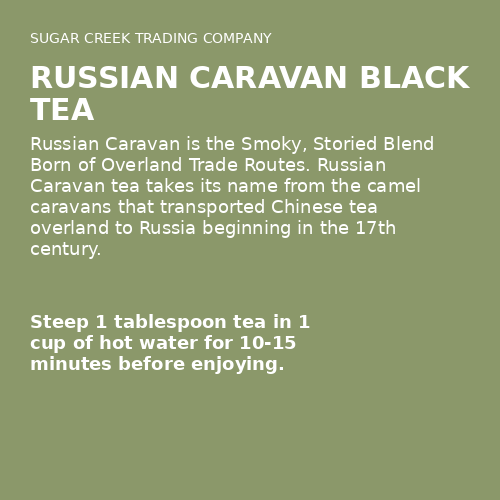
Russian Caravan Black Tea — The Smoky, Storied Blend Born of Overland Trade Routes
Botanical Identification
Common Names: Russian Caravan Tea, Caravan Blend, Karavanniy Chay (Russian)
Latin Name: Camellia sinensis (L.) Kuntze — blended from multiple processing styles of the same species
Family: Theaceae (Tea family)
Parts Used: Processed leaf and bud
Origin: Russian Caravan is not a single-origin tea but a traditional blend, typically composed of three Chinese teas: Keemun (Qimen) black tea from Anhui province, Lapsang Souchong smoked black tea from the Wuyi Mountains of Fujian province, and oolong tea (often a darker Fujian or Formosan variety). The exact ratio varies by blender, but the signature profile leans on Keemun's malty sweetness and Lapsang Souchong's pine-smoke character, with oolong providing body and floral complexity.
Appearance: The dry leaf is a mixture of tightly rolled and twisted dark leaves — the wiry black of Keemun, the larger smoky leaves of Lapsang Souchong, and the partially oxidized, sometimes greenish-brown leaves of the oolong component. The brewed liquor is a deep copper-amber with a distinctive smoky aroma layered over malt, dried fruit, and subtle orchid notes. The flavor is rich, full-bodied, and lingering, with the smoke present but integrated rather than overwhelming.
Cultural and Historical Use
Russian Caravan tea takes its name from the camel caravans that transported Chinese tea overland to Russia beginning in the 17th century. After the 1689 Treaty of Nerchinsk established trade between the Russian and Chinese empires, tea began its 11,000-mile journey from Fujian and Anhui provinces through Mongolia, across the Gobi Desert, through Siberia, and finally to Moscow and St. Petersburg. The journey took 16 to 18 months by camel.
This overland route, though vastly slower and more expensive than the maritime tea trade to Britain, produced tea of distinctly superior quality. Sea-transported tea arrived in London damp, musty, and degraded by months of humid ocean air in wooden-hulled ships. Caravan tea, by contrast, traveled through the cold, dry air of Central Asia and Siberia, arriving crisp, aromatic, and well-preserved. The Russian aristocracy prized this difference and willingly paid premium prices.
The smoky element in the blend carries its own legend. Some accounts attribute it to campfire smoke absorbed during the long overland journey. More practically, Lapsang Souchong — which is deliberately smoked over pinewood fires during processing — was included in caravan shipments because its robust, smoke-cured character survived the journey especially well. The blend as we know it today is a romanticized recreation of what those caravans might have carried, standardized by European tea blenders in the 19th and early 20th centuries.
Tea became central to Russian culture in ways that parallel but differ from British tea tradition. The samovar — the iconic Russian tea urn — became the social centerpiece of Russian households, and strong black tea (zavarka) diluted with hot water from the samovar remains the foundation of Russian tea service to this day.
Key Bioactive Compounds
| Compound | Class | Primary Action |
|---|---|---|
| Caffeine | Methylxanthine alkaloid | Central nervous system stimulant; adenosine receptor antagonist; enhances alertness and focus |
| L-Theanine | Amino acid | Promotes alpha brain wave activity; anxiolytic without sedation; smooths caffeine response |
| Theaflavins and Thearubigins | Oxidized polyphenols | Antioxidant; cardiovascular support; cholesterol metabolism modulation |
| Catechins (EGCG, ECG, etc.) | Flavanols | Antioxidant; anti-inflammatory; present in higher amounts in the oolong component |
| Theobromine | Methylxanthine alkaloid | Mild bronchodilator; gentle sustained stimulant; diuretic |
How It Works in the Body
The Caffeine-Theanine Synergy: Tea produces a qualitatively different stimulation than coffee, and this blend illustrates why. Caffeine blocks adenosine receptors, preventing the accumulation of the drowsiness signal. Simultaneously, L-theanine crosses the blood-brain barrier and promotes alpha brain wave production — the electrical rhythm associated with relaxed alertness, creative thinking, and calm focus. The result is a state that tea drinkers have described for centuries: alert without jittery, focused without anxious. Russian Caravan's blend of black and oolong teas provides roughly 40 to 70 mg of caffeine per 8 oz cup (depending on steeping time) alongside meaningful L-theanine levels.
Cardiovascular Support: The theaflavins formed during black tea oxidation have demonstrated lipid-modulating effects in clinical studies. They inhibit cholesterol synthesis through a mechanism distinct from statins and reduce intestinal cholesterol absorption. Regular black tea consumption (3 or more cups daily) is associated in epidemiological studies with reduced risk of stroke and coronary artery disease.
Antioxidant Activity: While green tea receives more attention for its catechin content, the oxidized polyphenols in black and oolong teas — theaflavins, thearubigins, and residual catechins — provide substantial antioxidant protection. The oolong component of Russian Caravan, being partially oxidized, retains a higher proportion of intact catechins than the fully oxidized black tea components.
Digestive Function: Black tea has a long history of use as a digestive beverage. The tannins (condensed polyphenols) exert a mild astringent effect on the intestinal mucosa, which can help with loose stools. The warmth and aromatic complexity of Russian Caravan make it particularly suited to after-meal consumption, where it can aid the transition from eating to digestion.
Dose Guidelines
| Preparation | Suggested Use | Notes |
|---|---|---|
| Standard brew | 1 teaspoon (2–3 g) per 8 oz water at 200–212 F, steep 3–5 minutes | 3 minutes for a lighter, more nuanced cup. 5 minutes for full body and stronger smoke character. |
| Russian-style (zavarka) | 3–4 teaspoons in a small teapot (12 oz), steep 5–7 minutes, dilute with hot water to taste | Produces a strong concentrate. Dilute 1:2 or 1:3 with hot water from a kettle. Traditional service method. |
| Daily consumption | 2–4 cups per day | Moderate intake for sustained alertness, cardiovascular polyphenol benefits, and digestive support. |
| Cold brew | 4–5 teaspoons per quart of cold water, refrigerate 8–12 hours, strain | Produces a smooth, low-tannin brew with prominent malt and subtle smoke. Excellent over ice. |
Preparation and Uses
- Western Brewing: Use freshly drawn, filtered water brought to a full boil (or just below, around 200 F, if you prefer less tannin extraction). Add 1 rounded teaspoon per cup. Steep 3 to 5 minutes. Russian Caravan tolerates slightly longer steeping than many black teas without becoming unpleasantly astringent, thanks to the oolong component's moderating influence.
- Russian Samovar Method: Prepare a concentrated zavarka by steeping 3 to 4 teaspoons in a small pot for 5 to 7 minutes. Pour a small amount into each cup, then dilute with plain hot water to desired strength. This method allows each drinker to customize their cup.
- With Milk: Russian Caravan takes milk well, though purists prefer it plain. A splash of whole milk softens the smoke and rounds the malt into a rich, almost cocoa-like body. Avoid pairing with delicate plant milks that may clash with the smoke notes.
- Food Pairings: The smoky-malty profile pairs beautifully with smoked salmon, dark rye bread, aged cheddar, dried fruits, and dark chocolate. It is a natural companion to Russian, Scandinavian, and Central European cuisines.
- Cooking: Use brewed Russian Caravan as a braising liquid for beef or pork, as the base for a smoky tea-poached salmon, or infused into cream for ice cream and panna cotta.
Optimal Context for Use
- Morning or early afternoon — a robust, engaging cup that provides steady caffeine and L-theanine for focused work
- Cold weather and fireside settings — the smoky warmth of this blend suits winter atmospheres perfectly
- After hearty meals — the tannin and aromatic complexity aid digestion and cleanse the palate
- As an alternative to coffee for those seeking a less abrupt, more sustained energy curve
- As an introduction to smoky teas — the blend format moderates the intensity that pure Lapsang Souchong can present to unaccustomed palates
Sustainability and Ethical Harvesting
Camellia sinensis is one of the most extensively cultivated crops on Earth, and the sustainability concerns surrounding tea are primarily social and environmental rather than species-level. Pesticide use on conventional tea estates, exploitative labor conditions on large plantations, and deforestation to expand tea acreage are all documented issues in major producing regions.
Where possible, choose Russian Caravan blends made from organically grown or sustainably certified component teas. Small-batch blenders who source from artisan estates in Anhui and Fujian provinces tend to offer better traceability and higher quality than mass-market blends. The traditional processing methods for Keemun and Lapsang Souchong — including the hand-smoking of Lapsang over native pine — are themselves cultural heritage practices worth supporting.
Safety and Cautions
- Caffeine Content: Contains moderate caffeine (40–70 mg per cup). Individuals sensitive to caffeine should limit consumption to earlier in the day and avoid exceeding 2 to 3 cups. Those with anxiety disorders, insomnia, or heart arrhythmias should consult a healthcare provider regarding caffeine intake.
- Pregnancy: Current guidelines suggest limiting caffeine to 200 mg per day during pregnancy. Two cups of Russian Caravan fall well within this limit, but total daily caffeine from all sources should be tracked.
- Iron Absorption: The tannins in black tea can reduce non-heme iron absorption by up to 60 percent when consumed with meals. Those at risk for iron deficiency should drink tea between meals rather than during them.
- Tannin Sensitivity: Over-steeped black tea can cause stomach discomfort in sensitive individuals due to high tannin content. Steep no longer than 5 minutes, or cold brew for a gentler extraction.
- Smoked Tea Components: Lapsang Souchong contains trace polycyclic aromatic hydrocarbons (PAHs) from the smoking process. In the context of a blended tea where Lapsang is one of three components, exposure is minimal, but those concerned about PAHs may wish to moderate intake.
This product has not been evaluated by the FDA. It is not intended to diagnose, treat, cure, or prevent any disease.
References
- Mair V, Hoh E. The True History of Tea. Thames and Hudson; 2009.
- Nobre AC, Rao A, Owen GN. "L-theanine, a natural constituent in tea, and its effect on mental state." Asia Pacific Journal of Clinical Nutrition. 2008;17(S1):167-168.
- Theo Ricketts J. "Theaflavins: nature's own cholesterol reducer." European Journal of Clinical Nutrition. 2003;57(S2):S74-S78.
- Hodgson JM, Croft KD. "Tea flavonoids and cardiovascular health." Molecular Aspects of Medicine. 2010;31(6):495-502.
- Heiss ML, Heiss RJ. The Story of Tea: A Cultural History and Drinking Guide. Ten Speed Press; 2007.
- Kuriyama S, et al. "Green tea consumption and mortality due to cardiovascular disease, cancer, and all causes in Japan." JAMA. 2006;296(10):1255-1265.
Final Note
Russian Caravan is a cup of compressed history — 11,000 miles of trade route, 18 months of camel caravan, and the collision of two great empires distilled into a single pot of tea. The smoky whisper of Lapsang Souchong evokes campfires across the Mongolian steppe. The malty depth of Keemun speaks to the centuries-old tea craftsmanship of Anhui province. And the oolong weaves them together with a floral, lingering sweetness that makes the blend more than the sum of its parts. This is not a tea for rushing. Brew it properly, pour it slowly, and let it transport you — as it has transported generations of drinkers — across vast distances without leaving your chair.
Share