Sugar Creek Trading Company
Sage White
Sage White
Couldn't load pickup availability
Salvia apiana
White Sage — Sacred Smoke of the Western Mountains
Botanical Identification
Species: Salvia apiana Jeps.
Family: Lamiaceae (Mint family)
Common Names: White Sage, Sacred Sage, Bee Sage, California White Sage
Plant Part Used: Dried leaves (loose)
Form: This product consists of loose, dried white sage leaves — the individual silvery-white leaves separated from the stem. This format is versatile: suitable for burning as loose incense, crafting custom smudge blends, preparing teas and infusions, or incorporating into herbal formulations. For pre-formed smudge bundles with stems attached, see our White Sage Tops With Stims listing.
Native Range: Coastal sage scrub communities of southern California and northwestern Baja California, Mexico, typically below 1,500 meters elevation
Aroma and Flavor: Intensely resinous and herbaceous with a sharp, clean, almost mentholated quality. When burned, it produces a thick, white, strongly aromatic smoke with deep camphoraceous and slightly sweet undertones. The flavor in tea is strongly bitter and astringent.
Cultural and Historical Use
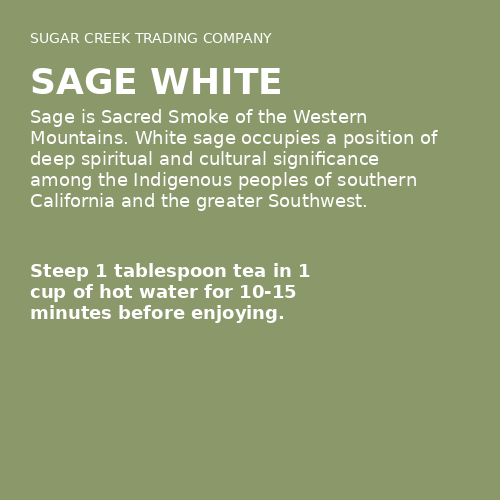
White sage occupies a position of deep spiritual and cultural significance among the Indigenous peoples of southern California and the greater Southwest. For the Cahuilla, Kumeyaay, Chumash, Tongva, and other Native nations of the region, white sage is far more than an aromatic plant — it is a sacred relative, a purifier, and a mediator between the physical and spiritual worlds.
In traditional Indigenous practice, white sage is burned in ceremony to cleanse spaces, objects, and individuals of negative or stagnant energies. It is used at the opening of gatherings, during prayer, in healing rituals, and to prepare sacred spaces. The practice commonly referred to as "smudging" in popular culture originates from these specific Indigenous ceremonial traditions, though the actual protocols, prayers, and contexts vary significantly between nations and should be respected as living cultural practices, not commodified aesthetics.
Medicinally, Indigenous peoples have used white sage as an antimicrobial wash for wounds, a tea for colds and respiratory ailments, a digestive aid, and a remedy for body aches. The Cahuilla crushed the leaves and mixed them with water for a hair shampoo and dye. Seeds of white sage, called "chia" (distinct from Salvia hispanica), were historically an important food source ground into pinole flour.
It is important to acknowledge that the explosive commercial demand for white sage since the 1990s has raised serious concerns among Indigenous communities about both cultural appropriation and ecological sustainability. We encourage all customers to approach this plant with respect, educate themselves about its cultural context, and consider whether their use honors or diminishes its significance.
Key Bioactive Compounds
| Compound | Class | Primary Activity |
|---|---|---|
| 1,8-Cineole (Eucalyptol) | Monoterpene oxide | Potent expectorant, anti-inflammatory, antimicrobial; dominant volatile in S. apiana |
| Camphor | Bicyclic monoterpene ketone | Respiratory stimulant, topical analgesic, insect repellent |
| Alpha-pinene and Beta-pinene | Monoterpenes | Bronchodilatory, anti-inflammatory, alertness-promoting |
| Rosmarinic acid | Polyphenol | Antioxidant, anti-inflammatory, antiviral |
| Flavonoids (luteolin, apigenin, hispidulin) | Flavones | Antioxidant, anti-inflammatory, anxiolytic |
| Terpene-rich resin compounds | Diterpenoids and sesquiterpenoids | Responsible for thick, persistent smoke; antimicrobial when aerosolized |
Important Distinction: Salvia apiana (white sage) has a notably different chemical profile from Salvia officinalis (common garden sage). White sage is dominated by 1,8-cineole and camphor with relatively low thujone, whereas common sage has significant thujone content. This makes white sage generally milder in terms of thujone-related concerns but more intensely camphoraceous.
How It Works in the Body
Respiratory Support: The high concentration of 1,8-cineole makes white sage a potent respiratory herb. Cineole acts as an expectorant, thinning mucus and facilitating its clearance from the airways. It also has demonstrated bronchodilatory and anti-inflammatory effects on the respiratory mucosa. Inhaling the smoke or steam of white sage has been traditionally used to ease breathing during colds and congestion.
Antimicrobial Smoke: A 2007 study published in the Journal of Ethnopharmacology demonstrated that medicinal smoke from burning herbs (a practice shared across many cultures globally) can reduce airborne bacterial counts by up to 94% in a closed room, with some effects persisting for 24 hours. While that study used a specific Ayurvedic blend, white sage's volatile oils — particularly cineole, camphor, and pinene — have independently demonstrated antimicrobial activity in laboratory settings.
Nervous System Effects: The terpene profile of white sage — rich in pinene, cineole, and camphor — produces a clarifying, alertness-promoting effect when inhaled. Traditional users report that burning white sage clears mental fog and promotes a sense of calm focus. These experiential reports align with the known pharmacology of the dominant terpenes: pinene promotes alertness, cineole enhances cognitive performance, and the ritual act of smudging itself may engage parasympathetic relaxation pathways.
Topical Antimicrobial: Infusions and poultices of white sage have been used traditionally as wound washes and skin treatments. The combined antimicrobial effects of cineole, camphor, and the plant's polyphenols support this application.
Dose Guidelines
| Preparation | Amount | Frequency | Notes |
|---|---|---|---|
| Loose Leaf Burning (smudge) | A pinch to a small handful | As desired | Burn in a fire-safe dish (abalone shell, ceramic bowl, or similar); ensure ventilation |
| Herbal Tea | 0.5-1 gram per cup | 1-2 times daily | Very strong flavor; start with small amounts. Steep covered 10 minutes. |
| Steam Inhalation | Small handful in bowl of hot water | As needed | Drape towel over head, inhale aromatic steam for respiratory comfort |
| Topical Wash | Strong infusion (2-3 g per cup), cooled | As needed | Traditional wound wash; for external use only in this application |
Preparation and Uses
- Loose Smudging: Place a pinch of loose dried leaves on a piece of charcoal in a fire-safe dish, or simply ignite a small pile of leaves directly and blow out the flame to produce a smoldering smoke. The loose leaf form allows you to control the amount precisely and blend white sage with other botanicals such as lavender, cedar, or sweetgrass.
- Space Clearing: Walk through a room or home carrying the smoking vessel, allowing the aromatic smoke to reach corners, doorways, and areas that feel energetically stagnant. Open a window to allow smoke and released energy to exit.
- Herbal Tea: White sage tea is intensely bitter and medicinally potent. Use sparingly — about half a gram of dried leaf per cup. Steep covered for 10 minutes. This preparation has been used traditionally for sore throats, digestive upset, and as a general tonic.
- Herbal Bath: Add a strong white sage infusion to bathwater for an aromatic, cleansing soak traditionally associated with purification and relaxation.
- Custom Smudge Blends: The loose leaf format is ideal for creating personalized smudge blends. Combine with dried rosemary, juniper, mugwort, palo santo shavings, or dried rose petals for layered aromatic experiences.
Optimal Context for Use
- For ceremonial and spiritual practice, space clearing, and energetic purification — approached with cultural awareness and respect
- As an aromatic smoke for meditation, prayer, or contemplative practice
- For respiratory support during seasonal congestion, as a steam inhalation or mild tea
- As a component of custom herbal smudge blends
- For those who prefer loose leaf over bundled smudge sticks, allowing more precise control over quantity and burn rate
Sustainability and Ethical Harvesting
The commercial white sage trade presents genuine ecological concerns that responsible buyers should understand. Salvia apiana grows wild in the coastal sage scrub ecosystem of southern California, one of the most threatened habitat types in North America — over 70% of this ecosystem has been lost to development. The surge in commercial demand for white sage, driven by the mainstream popularity of smudging since the early 2000s, has placed additional pressure on wild populations.
Reports of illegal poaching from public lands, including state parks and Indigenous gathering areas, have become increasingly common. Several Native nations and conservation organizations have raised alarms about unsustainable harvesting practices.
We encourage customers to consider the following: Purchase from suppliers who source cultivated white sage whenever possible. If wild-harvested, ensure the source uses sustainable methods — harvesting only a portion of each plant, never uprooting, and allowing seed production. Be mindful of the cultural weight this plant carries and use it intentionally, not casually. Supporting Native-owned businesses that sell white sage is one meaningful way to align your purchase with respect for both the plant and the cultures that have stewarded it.
Safety and Cautions
- Smoke Inhalation: While ceremonial smoke is used intentionally, prolonged or heavy smoke inhalation of any kind can irritate the lungs. Use in a well-ventilated area. Individuals with asthma, COPD, or other respiratory conditions should exercise caution with any form of smoke.
- Pregnancy: Avoid therapeutic internal use during pregnancy. The camphor and cineole content, while lower-risk than thujone, warrant caution in concentrated doses.
- Fire Safety: Always burn sage in a fire-safe container on a heat-proof surface. Never leave burning herbs unattended. Keep away from curtains, papers, and flammable materials.
- Internal Use: White sage tea is very potent. Start with small amounts to assess your tolerance. Not recommended for daily long-term internal use without guidance from a qualified herbalist.
- This product is sold as a botanical specimen. These statements have not been evaluated by the FDA. This product is not intended to diagnose, treat, cure, or prevent any disease.
References
- Nauber, C.S., et al. (2007). Medicinal smoke reduces airborne bacteria. Journal of Ethnopharmacology, 114(3), 446-451.
- Adams, J.D., et al. (2005). The pharmacology of Salvia apiana, a traditional medicine of the Chumash Indians. Pharmaceutical Biology, 43(6), 521-527.
- Blanc, M.C., et al. (2004). Essential oil composition of Salvia apiana from southern California. Flavour and Fragrance Journal, 19(2), 106-108.
- Walker, J.B., Sytsma, K.J. (2007). Staminal Evolution in the Genus Salvia (Lamiaceae). Annals of Botany, 100(2), 375-391.
- Timbrook, J. (1987). Virtuous Herbs: Plants in Chumash Medicine. Journal of Ethnobiology, 7(2), 171-180.
Final Note: White sage is a plant that asks something of those who use it — awareness, intention, and respect. Whether you are drawn to it for its powerful aromatic qualities, its traditional role in ceremonial purification, or its genuine medicinal properties, we encourage you to learn about the Indigenous traditions that have held this plant sacred for thousands of years and to use it in ways that honor both the plant and its cultural stewards.
Share