Sugar Creek Trading Company
Saw Palmetto Berry
Saw Palmetto Berry
Couldn't load pickup availability
Serenoa repens
Saw Palmetto Berry — The Prostate Guardian of the American Southeast
Botanical Identification
Species: Serenoa repens (W. Bartram) Small
Family: Arecaceae (Palm family)
Common Names: Saw Palmetto Berry, Sabal, Cabbage Palm Berry, Fan Palm Berry
Plant Part Used: Ripe dried berry (drupe)
Form: Whole dried berries
Origin: Southeastern United States, primarily Florida and coastal Carolinas
Saw palmetto is a low-growing, clumping fan palm native to the sandy soils and pine flatwoods of the American Southeast. The plant produces clusters of dark purple-black drupes, each roughly olive-sized, with a single hard seed surrounded by a thin layer of oily, aromatic flesh. This listing features the whole dried berry form, which preserves the full lipid profile of the fruit, including its fatty acid content and volatile aromatic compounds. Whole berries are ideal for those who prefer to grind or prepare their own extracts, tinctures, or decoctions, retaining maximum potency and shelf life compared to pre-powdered material.
Cultural and Historical Use
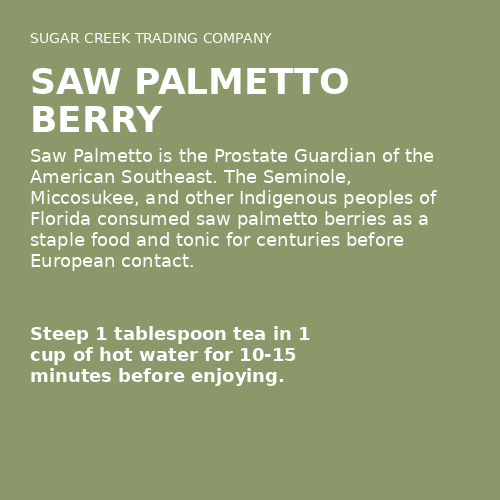
The Seminole, Miccosukee, and other Indigenous peoples of Florida consumed saw palmetto berries as a staple food and tonic for centuries before European contact. Early Spanish explorers documented the fruit as a dietary mainstay among coastal Native populations. By the late 1800s, American Eclectic physicians championed saw palmetto berry as a "nutritive tonic" for wasting conditions, urinary complaints, and reproductive health in both men and women. The berry appeared in the U.S. Pharmacopeia from 1906 to 1916 and in the National Formulary through 1950.
In the modern era, saw palmetto became one of the most extensively studied herbal remedies in the world, particularly in European phytotherapy, where liposterolic extracts are prescribed as first-line treatments for benign prostatic hyperplasia (BPH) in countries such as Germany, France, and Italy. The whole berry remains the traditional starting material for all such preparations.
Key Bioactive Compounds
| Compound Class | Notable Examples | Primary Activity |
|---|---|---|
| Fatty Acids | Lauric acid, oleic acid, myristic acid, palmitic acid | 5-alpha-reductase inhibition; anti-inflammatory |
| Phytosterols | Beta-sitosterol, stigmasterol, campesterol | Anti-androgenic activity; urinary flow improvement |
| Flavonoids | Rutin, isoquercitrin, kaempferol glycosides | Antioxidant; vascular protection |
| Polysaccharides | High-molecular-weight galactomannans | Immune modulation |
| Volatile Oils | Farnesol, various sesquiterpenes | Antimicrobial; aromatic |
How It Works in the Body
The primary mechanism of saw palmetto berry centers on its ability to inhibit the enzyme 5-alpha-reductase, which converts testosterone to dihydrotestosterone (DHT). Elevated DHT is a key driver of prostate tissue proliferation in BPH and is implicated in androgenic alopecia. The fatty acid fraction, particularly lauric acid and oleic acid, appears responsible for this inhibition, working through a non-competitive binding mechanism on both Type I and Type II isoforms of the enzyme.
Beyond hormonal pathways, saw palmetto exerts anti-inflammatory effects by inhibiting cyclooxygenase (COX) and 5-lipoxygenase (5-LOX) enzymes, reducing prostaglandin and leukotriene production in prostatic tissue. The phytosterol content, especially beta-sitosterol, independently improves urinary flow parameters and reduces residual bladder volume. These combined actions explain the broad clinical improvements reported in urinary frequency, nocturia, hesitancy, and weak stream.
The whole berry form provides the complete spectrum of these active lipids in their native matrix, which may support absorption and bioavailability when prepared as oil-based extracts or when chewed and consumed directly.
Dose Guidelines
| Preparation | Amount | Frequency | Notes |
|---|---|---|---|
| Whole Berries (decoction) | 2-4 grams dried berries | Simmered 15-20 min, 1-2 times daily | Crush lightly before simmering to release oils |
| Tincture (homemade) | 1:5 ratio in 60-70% alcohol | 2-4 mL, 2-3 times daily | Macerate crushed berries for 4-6 weeks |
| Powdered Berry | 1-2 grams | 1-2 times daily | Grind fresh; consume with a fat source for absorption |
| Standardized Extract (reference) | 160 mg (85-95% fatty acids) | Twice daily | Clinical trial standard; whole berries approximate this |
Preparation and Uses
- Decoction: Lightly crush 2-4 grams of dried berries with a mortar and pestle. Simmer in 2 cups of water for 15-20 minutes. Strain and drink warm. The tea will have a slightly oily, sweet, and mildly astringent flavor.
- Tincture: Fill a jar one-third full with crushed berries and cover with 60-70% grain alcohol. Seal and store in a cool, dark place for 4-6 weeks, shaking daily. Strain and bottle. The high alcohol percentage is necessary to extract the lipophilic compounds.
- Infused Oil: Crush berries and cover with olive oil or coconut oil at a 1:5 ratio. Warm gently (not above 110 degrees F) for several hours or let sit for 4-6 weeks. Strain. This oil can be taken internally (1 teaspoon daily) or used topically on the scalp for hair health.
- Direct Consumption: Some traditional practitioners recommend chewing 4-6 dried berries daily, swallowing the pulp and discarding the seed.
Optimal Context for Use
- Prostate Health: Men over 40 experiencing early signs of urinary difficulty, including frequent urination, weak stream, or nighttime waking to urinate.
- Hormonal Balance: Those seeking a gentle, food-grade approach to managing DHT-related concerns, including thinning hair in both men and women.
- Long-Term Tonic: Saw palmetto is traditionally used as a nutritive tonic during convalescence, underweight conditions, or general debility, reflecting its historical Eclectic use.
- Complementary Support: Often combined with nettle root, pygeum bark, or pumpkin seed for comprehensive prostate formulas.
Sustainability and Ethical Harvesting
Saw palmetto berries are wild-harvested almost exclusively from native stands in Florida. The plant is abundant and not currently endangered, but increasing commercial demand has raised concerns about overharvesting in some regions. Responsible sourcing prioritizes harvesting from abundant stands on private or managed lands, leaving adequate fruit for wildlife, particularly the Florida black bear, which depends heavily on the berries as a caloric food source. Ethical wildcrafters harvest no more than one-third of the fruit from any given stand and avoid harvesting from environmentally sensitive areas. We source our saw palmetto berries from suppliers who follow sustainable wild-harvesting guidelines.
Safety and Cautions
- Generally well-tolerated. Saw palmetto has an excellent safety profile in clinical studies, with side effects limited to occasional mild stomach upset.
- Hormonal medications: May interact with hormone therapies, oral contraceptives, or antiandrogen drugs. Consult a healthcare provider if you take any hormonal medication.
- Anticoagulants: Rare case reports suggest a theoretical interaction with blood-thinning medications. Use caution and inform your provider.
- Pregnancy and breastfeeding: Not recommended due to antiandrogenic activity.
- PSA testing: Some evidence suggests saw palmetto may lower PSA levels, which could mask prostate cancer detection. Inform your physician of use before PSA screening.
- Surgery: Discontinue 2 weeks before scheduled surgery due to theoretical bleeding risk.
This product is not intended to diagnose, treat, cure, or prevent any disease. Consult a qualified healthcare provider before use, especially if you have a medical condition or take medications.
References
- Blumenthal, M., et al. The Complete German Commission E Monographs. American Botanical Council, 1998.
- Wilt, T.J., et al. "Serenoa repens for benign prostatic hyperplasia." Cochrane Database of Systematic Reviews, 2002.
- Penugonda, K., and Lindshield, B.L. "Fatty acid profile of saw palmetto extract." Journal of the American Oil Chemists' Society, 2013.
- Suzuki, M., et al. "Pharmacological effects of saw palmetto extract in lower urinary tract symptoms." Acta Pharmacologica Sinica, 2009.
- Bennett, B.C., and Hicklin, J.R. "Uses of saw palmetto (Serenoa repens) in Florida." Economic Botany, 1998.
Final Note
Saw palmetto berry is one of America's most important native medicinal plants, carrying centuries of Indigenous knowledge and over a hundred years of Western clinical investigation. In whole dried berry form, you receive the plant exactly as nature produced it — a complete package of fatty acids, sterols, and aromatic compounds ready to be prepared however you choose. Whether simmered into a traditional decoction, tinctured in alcohol, or simply chewed as the Seminole once did, these small, dark fruits represent a gentle yet effective approach to prostate health and hormonal balance that has stood the test of time.
Share