Sugar Creek Trading Company
Turkey Rhubarb Root
Turkey Rhubarb Root
Couldn't load pickup availability
RHEUM PALMATUM (RHIZOME / ROOT)
(Chinese Rhubarb, Da Huang)
Family: Polygonaceae
Part Used: Rhizome and root
Energetics: Cold, drying, strongly descending
Taste: Bitter, astringent
BOTANICAL IDENTIFICATION
Scientific Name: Rheum palmatum L.
Common Names: Chinese Rhubarb, Da Huang
Family: Polygonaceae
Morphology:
Rheum palmatum is a robust perennial herb reaching 1.5–2.5 meters (5–8 ft) in height. Leaves are very large, palmately lobed, and deeply veined, borne on thick petioles arising from a massive underground rhizome. The leaf blades can exceed 60 cm in diameter.
Flowers are small, greenish to reddish, borne in large, branching panicles. Fruits are three-winged achenes typical of the Polygonaceae.
The medicinal portion consists of the thick rhizome and associated roots, yellow-brown externally and bright yellow to orange internally when freshly cut.
Root system:
A large, woody rhizome with extensive secondary roots, functioning as a storage organ for carbohydrates and secondary metabolites that support overwintering and regrowth.
HABITAT, RANGE, AND ADAPTATIONS
Chinese rhubarb is native to western China and the eastern Tibetan Plateau, growing at high elevations (2,000–4,000 m) in cool mountain climates.
It thrives in well-drained, mineral-rich soils with cold winters and short growing seasons. Adaptations include the accumulation of anthraquinones and tannins, which protect the root from herbivores, microbes, and decay during long dormancy periods.
CULTIVATION AND ECOLOGY
Rheum palmatum is cultivated in China and neighboring regions for medicinal use, typically requiring 6–10 years to produce roots of optimal quality.
The plant is slow-growing and sensitive to soil disturbance. Ecologically, it contributes to alpine meadow systems and stabilizes soils in mountainous terrain.
TRADITIONAL AND ETHNOBOTANICAL USE
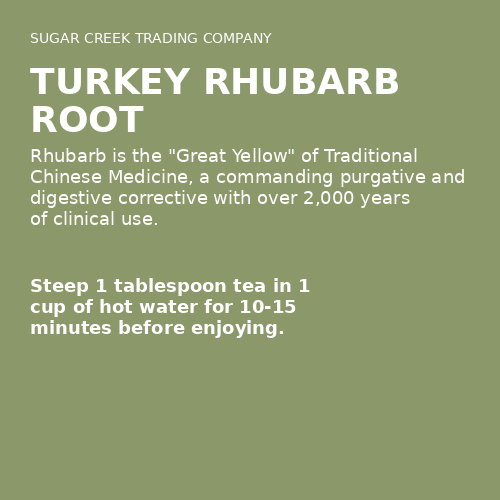
Rheum palmatum is one of the most important herbs in Traditional Chinese Medicine, with documented use for over 2,000 years. Known as Da Huang, it is classified as a drastic purgative and heat-clearing herb.
Traditionally, it is used to purge heat accumulation, move stagnant blood, clear toxins, drain damp-heat, and reduce inflammation. Classical indications include severe constipation, abdominal fullness, jaundice, febrile diseases, abscesses, and blood stasis.
In small or aged preparations, Da Huang is also used as an astringent and blood-tonifying agent, demonstrating its dose-dependent duality.
Chinese rhubarb entered Western medicine in the 17th century and became a standard pharmacopeial drug as both a laxative and bitter tonic, influencing modern pharmacology of anthraquinone laxatives.
KEY BIOACTIVE COMPOUNDS AND BENEFITS
| Compound Class | Representative Compounds | Role in Plant | Human Benefits |
|---|---|---|---|
| Anthraquinones | Rhein, emodin, aloe-emodin | Chemical defense against herbivores and microbes | Laxative, antimicrobial, anti-inflammatory |
| Dianthrones | Sennosides | Enhanced deterrent compounds | Potent stimulant laxative |
| Tannins | Catechin-type tannins | Tissue protection and decay resistance | Astringent, anti-diarrheal (low dose) |
| Stilbenes | Rhaponticin | Stress and UV defense | Anti-inflammatory, antioxidant |
| Polysaccharides | Storage carbohydrates | Energy storage | Gut-soothing, immunomodulatory (minor) |
The balance between anthraquinones and tannins determines whether the herb acts as a purgative or an astringent.
HOW IT WORKS IN THE BODY
Laxative and Purgative Action:
Anthraquinones stimulate colonic peristalsis and inhibit water reabsorption in the large intestine, producing a strong laxative effect typically within 6–12 hours.
Anti-inflammatory and Antimicrobial Effects:
Emodin and rhein modulate inflammatory signaling and inhibit bacterial growth, contributing to Da Huang’s use in infections and inflammatory conditions.
Dose-Dependent Duality:
At high doses, purgative anthraquinones dominate. At low or aged doses, tannins exert a contracting, anti-diarrheal effect, illustrating classic bidirectional herbal action.
ACTIONS AND INDICATIONS
Rheum palmatum acts as a drastic laxative, purgative, heat-clearing agent, antimicrobial, anti-inflammatory, and blood-moving herb.
It is indicated for severe constipation, bowel obstruction patterns, heat-induced delirium, jaundice, inflammatory abdominal pain, abscesses, and acute toxic accumulations.
Its use requires precision and restraint; it is not a gentle tonic.
PREPARATIONS AND DOSAGE
| Form | Preparation | Suggested Dose | Notes |
|---|---|---|---|
| Decoction | 0.5–2 g dried root simmered briefly | Single dose as needed | Strong purgative |
| Powder | Finely powdered root | 0.2–1 g | Low-dose regulation |
| Tincture (1:5, 60%) | Dried root | 0.5–2 mL | Rare in Western use |
| Topical wash | Weak decoction | External use | Infected wounds |
In TCM, Da Huang is almost always formulated with other herbs to guide and moderate its action.
SAFETY, CONTRAINDICATIONS, AND TOXICITY
Chinese rhubarb must be used short-term and with professional guidance.
Contraindicated in pregnancy, lactation, intestinal obstruction due to weakness, inflammatory bowel disease flares, dehydration, and electrolyte imbalance.
Chronic or excessive use may cause cramping, diarrhea, potassium depletion, dependency, and intestinal atony.
General Toxicological Reference (LD₅₀)
-
Whole Rheum palmatum root preparations:
Acute oral toxicity studies in animals report LD₅₀ values generally in the range of 2,000–5,000 mg/kg -
Isolated anthraquinones (e.g., emodin):
Oral LD₅₀ values in rodents reported approximately 500–1,000 mg/kg
Clinical relevance:
Whole-root preparations have a wider safety margin than isolated anthraquinones, but misuse carries real risk due to potent pharmacological effects.
HARVEST AND PROCESSING
Roots are harvested after 6–10 years, typically in autumn. Traditional processing includes boiling, steaming, or wine-processing, which alters anthraquinone activity and moderates harshness.
Proper aging improves balance between purgative and astringent effects.
SUSTAINABILITY AND CONSERVATION
Wild populations of Rheum palmatum have been overharvested in parts of its native range. Sustainable use depends on cultivation, long rotation periods, and regulated harvest.
Ethical sourcing is essential due to slow growth and ecological sensitivity.
SUMMARY
Chinese rhubarb is a medicine of force and discernment. It clears what is dangerously accumulated—heat, toxicity, stagnation—when gentler remedies are insufficient.
Rheum palmatum teaches one of herbalism’s most important lessons: power must be guided. In skilled hands, it saves lives; without restraint, it depletes them. Used correctly, it remains one of the most consequential roots in the global materia medica.
Share