Sugar Creek Trading Company
Watercress
Watercress
Couldn't load pickup availability
NASTURTIUM OFFICINALE (AERIAL PARTS)
(Watercress, Garden Cress, True Cress)
Family: Brassicaceae
Part Used: Fresh aerial parts (leaves and stems); seed secondary
Energetics: Cooling, moistening, gently stimulating
Taste: Pungent, peppery, slightly bitter
BOTANICAL IDENTIFICATION
Scientific Name: Nasturtium officinale W.T. Aiton
Common Names: Watercress, Garden Cress, True Cress
Family: Brassicaceae
Morphology:
Nasturtium officinale is a perennial, semi-aquatic herb with creeping, hollow stems that root at the nodes. It typically grows 15–50 cm (6–20 in) tall, forming dense mats in flowing water. Leaves are pinnate with rounded to ovate leaflets, glossy green, and succulent. Flowers are small, white, four-petaled (cruciform), borne in terminal clusters; fruits are short siliques containing small seeds.
Root system:
Adventitious roots emerge from stem nodes, anchoring the plant to substrates in streams and springs and enabling rapid vegetative spread.
HABITAT, RANGE, AND ADAPTATIONS
Watercress is native to Europe, western Asia, and North Africa, and is now naturalized worldwide. It thrives in cool, clean, flowing freshwater—springs, streams, ditches, and seeps—preferring alkaline to neutral conditions.
Adaptations include hollow stems for buoyancy and oxygen transport, rapid vegetative propagation, and high concentrations of glucosinolates that deter herbivory and microbial growth in aquatic environments.
CULTIVATION AND ECOLOGY
Nasturtium officinale is easily cultivated in flowing-water systems or shallow trays with continuous circulation. It prefers cool temperatures and partial sun.
Ecologically, watercress stabilizes stream margins, provides habitat for aquatic invertebrates, and contributes to nutrient cycling. Because it can accumulate contaminants, it serves as a bioindicator of water quality.
TRADITIONAL AND ETHNOBOTANICAL USE
Watercress has a long history as a spring tonic and nutritive medicine in European traditions. Classical authors, including Dioscorides, described its use for scurvy, digestive weakness, and respiratory congestion.
Across Europe and the British Isles, watercress was eaten fresh to “clean the blood,” stimulate digestion, and strengthen the lungs. It was also used for anemia, fatigue, skin eruptions, and urinary complaints.
In traditional herbalism, watercress bridged food and medicine, valued for its pungency, mineral richness, and ability to stimulate elimination and metabolism.
Modern herbalists continue to use watercress as a nutritive alterative, especially where deficiency, sluggish metabolism, or mild respiratory congestion are present.
KEY BIOACTIVE COMPOUNDS AND BENEFITS
| Compound Class | Representative Compounds | Role in Plant | Human Benefits |
|---|---|---|---|
| Glucosinolates | Gluconasturtiin | Chemical defense against herbivores | Detoxification support, antimicrobial |
| Isothiocyanates | Phenethyl isothiocyanate (PEITC) | Breakdown products for pest deterrence | Antioxidant, chemoprotective |
| Vitamins | Vitamin C, vitamin A (β-carotene), vitamin K | Growth and stress resilience | Immune support, antioxidant |
| Minerals | Iron, calcium, iodine (trace) | Structural and metabolic support | Hematopoiesis, thyroid support |
| Flavonoids | Quercetin, kaempferol | UV protection and oxidative buffering | Anti-inflammatory |
| Chlorophyll | Chlorophyll a & b | Photosynthesis | Detoxification, nutritive support |
Phenethyl isothiocyanate (PEITC) is particularly well studied for its antioxidant and xenobiotic-modulating properties.
HOW IT WORKS IN THE BODY
Metabolic and Detoxification Support:
Glucosinolates are enzymatically converted to isothiocyanates, which activate phase II detoxification enzymes and support hepatic clearance of metabolic waste.
Respiratory and Digestive Effects:
The pungent, warming compounds stimulate digestion and gently loosen mucus, supporting respiratory clearance without drying tissues.
Nutritional Repletion:
High vitamin and mineral density supports blood health, immune resilience, and connective tissue repair, especially in deficiency states.
ACTIONS AND INDICATIONS
Nasturtium officinale acts as a nutritive tonic, alterative, mild expectorant, digestive stimulant, diuretic, and antioxidant.
It is indicated for nutritional deficiency, anemia patterns (supportive), fatigue, spring sluggishness, mild respiratory congestion, skin conditions linked to poor elimination, and metabolic stagnation.
PREPARATIONS AND DOSAGE
| Form | Preparation | Suggested Dose | Notes |
|---|---|---|---|
| Fresh plant (food) | Raw or lightly cooked | Ad libitum | Best nutritive form |
| Fresh juice | Pressed aerial parts | 10–30 mL daily | Potent; start low |
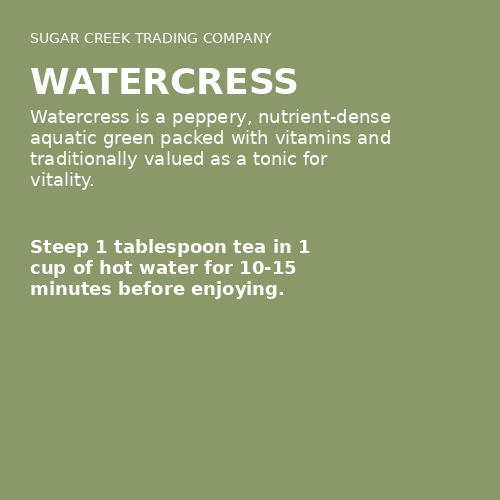
| Infusion | 1–2 tsp fresh herb per cup hot water | 1 cup, 1–2× daily | Mild medicinal |
| Tincture (1:5, 30–40%) | Fresh herb | 2–4 mL, 2× daily | Less common |
Watercress pairs well with Yellow Dock, Nettle Leaf, Dandelion, and Cleavers in alterative and nutritive formulas.
SAFETY, CONTRAINDICATIONS, AND TOXICITY
Watercress is generally very safe when sourced from clean, uncontaminated water.
Avoid harvesting from polluted waterways due to the risk of heavy metals, pathogens, or parasites (e.g., Fasciola spp.). Individuals with hypothyroidism should use moderation due to mild goitrogenic potential when consumed in very large quantities.
No significant drug interactions are documented.
General Toxicological Reference (LD₅₀)
-
Whole Nasturtium officinale aerial-part preparations:
Acute toxicity studies indicate extremely low toxicity, with oral LD₅₀ values in animal models reported as >5,000 mg/kg -
Phenethyl isothiocyanate (isolated):
Oral LD₅₀ values in rodents reported in the range of >1,000 mg/kg
Clinical relevance:
These values support watercress’s role as a safe daily food-medicine with wide margins of safety.
HARVEST AND PROCESSING
Harvest fresh aerial parts year-round from clean, flowing water sources. Cut above nodes to encourage regrowth. For medicinal use, consume fresh whenever possible; drying significantly reduces potency.
SUSTAINABILITY AND CONSERVATION
Nasturtium officinale is locally abundant but sensitive to water pollution. Ethical harvesting emphasizes waterway protection and cultivation in controlled systems.
As a living filter and nutrient cycler, watercress highlights the connection between ecosystem health and human medicine.
SUMMARY
Watercress is medicine as nourishment—cool, pungent, and revitalizing. It clears stagnation gently, replenishes what is missing, and supports the body’s innate capacity to detoxify and renew.
Rooted in clean water and rich minerals, Nasturtium officinale exemplifies the principle that true cleansing is inseparable from nourishment, making it a cornerstone of restorative and preventative herbal practice.
Share