Sugar Creek Trading Company
Wild Cherry Bark
Wild Cherry Bark
Couldn't load pickup availability
Prunus serotina Ehrh.
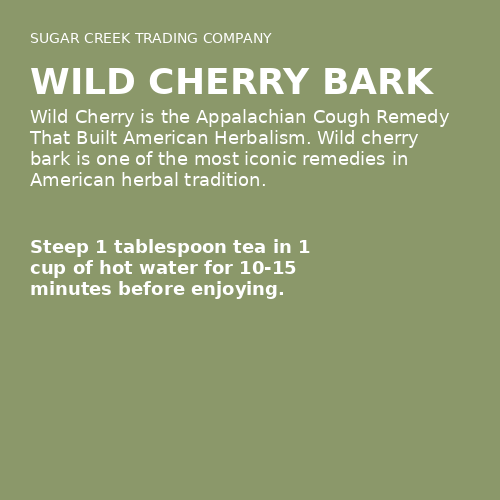
Wild Cherry Bark — The Appalachian Cough Remedy That Built American Herbalism
Botanical Identification
- Common Names: Wild Cherry Bark, Black Cherry Bark, Rum Cherry, Mountain Black Cherry, Chokecherry (sometimes confused)
- Latin Binomial: Prunus serotina Ehrh.
- Family: Rosaceae
- Part Used: Inner bark (collected in autumn when cyanogenic glycoside content is optimal)
- Origin: Eastern North America, from Nova Scotia to Florida, west to the Great Plains
- Appearance: Reddish-brown bark strips or chips with a characteristic bitter almond aroma
- Flavor: Bitter, astringent, with a distinctive almond-cherry warmth
Cultural and Historical Use
Wild cherry bark is one of the most iconic remedies in American herbal tradition. The Cherokee, Mohegan, Ojibwe, and many other Indigenous nations used preparations of the inner bark for coughs, colds, and fevers long before European colonization. Cherokee healers prepared bark infusions to ease labor pains and treat diarrhea, while the Mohegan used it as a general tonic for respiratory congestion.
European settlers quickly adopted wild cherry bark as a primary cough remedy. By the late 18th century, it was included in virtually every American materia medica. The Eclectic physicians — a major school of American botanical medicine active from the 1830s through the 1930s — considered wild cherry bark indispensable for "irritable cough with debility." Dr. John King's American Dispensatory (1854) devoted extensive pages to its preparation.
Wild cherry bark syrup became one of the most commercially successful herbal preparations in American history. Pharmaceutical companies including Smith Brothers and later over-the-counter brands incorporated wild cherry flavoring (both real and synthetic) into cough drops and syrups that remain on shelves today. The U.S. Pharmacopeia listed wild cherry bark from 1820 through 1970, and the National Formulary carried it until 1975.
Key Bioactive Compounds
| Compound | Class | Notes |
|---|---|---|
| Prunasin | Cyanogenic glycoside | Primary active constituent; hydrolyzes to release small amounts of hydrogen cyanide, which acts as a local sedative to the cough reflex |
| Amygdalin | Cyanogenic glycoside | Present in smaller quantities; related compound found in many Prunus species |
| Scopoletin | Coumarin | Antispasmodic and mild anti-inflammatory activity |
| Tannins (condensed) | Polyphenols | Astringent; help tone mucous membranes and reduce excess secretions |
| p-Coumaric acid | Hydroxycinnamic acid | Antioxidant; supports vascular integrity |
| Benzaldehyde | Aromatic aldehyde | Produces the characteristic bitter almond/cherry aroma and flavor |
How It Works in the Body
Wild cherry bark's primary mechanism of action centers on the cyanogenic glycoside prunasin. When ingested, enzymatic hydrolysis releases trace amounts of hydrocyanic acid (HCN) in the gut and tissues. At the very small concentrations released by standard herbal doses, HCN acts as a local sedative to the sensory nerves of the cough reflex arc in the respiratory mucosa. This quiets the irritated cough without full central nervous system depression — a gentler mechanism than codeine-based suppressants.
The condensed tannins contribute an astringent, tissue-toning action on the mucous membranes of the throat and bronchi. This helps reduce excessive mucus production and calms inflamed, "boggy" respiratory tissue. Scopoletin provides mild antispasmodic activity, relaxing smooth muscle in the bronchial passages and reducing the spasmodic component of coughs.
Together, these actions make wild cherry bark particularly well-suited for dry, irritable, spasmodic coughs — the kind that keep a person awake at night but are not productively clearing congestion. Herbalists typically pair it with expectorant herbs when productive coughing is needed.
Dose Guidelines
| Preparation | Amount | Frequency / Notes |
|---|---|---|
| Cold infusion (preferred) | 1-2 teaspoons bark per cup of cold or room-temp water, steeped 4-8 hours | 2-4 oz up to 3-4 times daily; cold infusion preserves cyanogenic glycosides better than hot water |
| Tincture (1:5, 40-50% ethanol) | 2-4 mL (approx. 40-80 drops) | Up to 3 times daily |
| Syrup | 1-2 tablespoons of prepared syrup | Every 3-4 hours as needed for cough; traditional vehicle for this herb |
| Decoction (less preferred) | 1-2 teaspoons per cup, simmered gently 10-15 minutes | Boiling drives off volatile HCN; some herbalists prefer cold preparation for this reason |
Preparation and Uses
- Cold Infusion: The traditional and often preferred method. Place 1-2 teaspoons of dried bark in a jar of cold or room-temperature water. Allow to steep for 4-8 hours or overnight. Strain and drink in small doses throughout the day. Cold extraction preserves the volatile cyanogenic glycosides that are partially lost during boiling.
- Wild Cherry Bark Syrup: Prepare a strong cold infusion. Strain and combine 1:1 with raw honey (or 2:1 infusion to honey for a thinner syrup). Store refrigerated for up to 3-4 weeks. This is the classic preparation for nighttime coughs.
- Cough Formula Blending: Wild cherry bark combines beautifully with elecampane (for deeper lung congestion), marshmallow root (to soothe dry throat), mullein leaf (for general respiratory support), and licorice root (for flavor and demulcent action).
- Tincture: Macerate bark in 40-50% alcohol for 4-6 weeks. This is a convenient form for acute dosing during cough and cold season.
Optimal Context for Use
- Dry, spasmodic, irritable coughs — especially those that worsen at night and prevent sleep
- Post-nasal drip cough and persistent tickle in the throat
- Recovery phase of colds and bronchitis when active infection has cleared but cough lingers
- As part of a broader respiratory formula alongside expectorants and demulcents
- Digestive bitter — the tannins and bitter compounds gently stimulate digestion as a secondary use
Sustainability and Ethical Harvesting
Prunus serotina is abundant throughout eastern North America and is not considered threatened. In fact, in parts of Europe where it was introduced as an ornamental, it is classified as invasive. Wild cherry bark can be ethically wildcrafted from fallen branches or sustainably harvested from living trees by taking bark from limbs rather than the main trunk, which avoids girdling and killing the tree.
Autumn-harvested bark is traditionally preferred because cyanogenic glycoside content is highest after the growing season. Bark from younger branches (3-5 years of growth) is considered more potent than old trunk bark. Responsible harvesters take only what is needed and never ring-bark a living tree.
Safety and Cautions
- Do not exceed recommended doses. Prunasin releases hydrogen cyanide upon hydrolysis. At standard herbal doses this is safe, but excessive consumption could theoretically cause toxicity. Symptoms of overconsumption include headache, dizziness, and nausea.
- Pregnancy and breastfeeding: Avoid use during pregnancy due to the cyanogenic glycoside content. Not recommended during breastfeeding without professional guidance.
- Children: Wild cherry bark syrup has a long history of use in children, but dose should be reduced proportionally to body weight. Consult a qualified herbalist for pediatric use.
- Not for productive coughs: Wild cherry bark is a cough suppressant. Do not use to suppress coughs that are actively and productively clearing congestion from the lungs — that cough is doing important work.
- Wilted leaves: Fresh, wilted leaves of Prunus serotina are toxic to livestock. This concern applies to the leaves, not the properly prepared bark, but it is worth noting for those who may forage.
- Short-term use is preferred. Most herbalists recommend courses of 1-2 weeks rather than long-term daily use.
References
- Felter, H. W. and Lloyd, J. U. King's American Dispensatory, 18th edition. Ohio Valley Company, 1898.
- Moerman, D. E. Native American Ethnobotany. Timber Press, 1998.
- Ellingwood, F. American Materia Medica, Therapeutics and Pharmacognosy. Eclectic Medical Publications, 1919.
- Brinker, F. Herb Contraindications and Drug Interactions, 4th edition. Eclectic Medical Publications, 2010.
- Upton, R., et al. American Herbal Pharmacopoeia: Wild Cherry Bark. AHP, 2000.
- Duke, J. A. Handbook of Phytochemical Constituents of GRAS Herbs. CRC Press, 1992.
This product is sold as a dried herbal botanical. It is not intended to diagnose, treat, cure, or prevent any disease. Consult a qualified healthcare provider before use, especially if pregnant, nursing, or taking medications.
Share