Sugar Creek Trading Company
Wormwood
Wormwood
Couldn't load pickup availability
ARTEMISIA ABSINTHIUM
(Wormwood, Absinthe Wormwood, Green Ginger)
Family: Asteraceae
Part Used: Aerial parts (leaves and flowering tops)
Energetics: Cold, drying, strongly dispersing
Taste: Intensely bitter, aromatic
BOTANICAL IDENTIFICATION
Scientific Name: Artemisia absinthium L.
Common Names: Wormwood, Absinthe Wormwood, Green Ginger
Family: Asteraceae
Morphology:
Artemisia absinthium is a woody-based perennial herb reaching 60–120 cm in height, with erect, branched stems covered in fine silvery-gray hairs. Leaves are deeply lobed, pinnatifid, and densely pubescent, giving the plant its characteristic gray-green appearance and penetrating aroma. Flowers are small, globular, yellowish-green, and borne in loose panicles during mid to late summer.
Root system:
A shallow but spreading perennial root crown allowing regrowth after cutting and survival in dry, disturbed soils.
HABITAT, RANGE, AND ADAPTATIONS
Native to Europe, western Asia, and North Africa, wormwood is now naturalized throughout North America and temperate regions worldwide. It thrives in dry, poor, or calcareous soils and tolerates drought and full sun.
High concentrations of bitter sesquiterpene lactones and volatile oils act as strong chemical deterrents against herbivores, insects, and microbes. Silvery trichomes reduce transpiration and reflect excess solar radiation.
CULTIVATION AND ECOLOGY
Artemisia absinthium is easily cultivated but chemically assertive. It exhibits allelopathic effects, inhibiting the growth of neighboring plants through root exudates. While useful for soil stabilization, it must be managed carefully to avoid ecological suppression.
TRADITIONAL AND ETHNOBOTANICAL USE
Wormwood has been used for over two millennia across Greek, Roman, Persian, and European traditions as a vermifuge, digestive bitter, febrifuge, and protective herb. Classical authors including Hippocrates, Dioscorides, and Galen documented its use for intestinal worms, liver obstruction, and melancholic conditions.
Throughout European folk medicine, it was also used to repel insects, protect stored grains, and ward illness. Its later association with absinthe brought notoriety, though historical toxicity was largely linked to adulterants and excessive alcohol rather than whole-plant use alone.
Modern herbalism employs wormwood sparingly for parasitic infections and severe digestive stagnation.
KEY BIOACTIVE COMPOUNDS AND BENEFITS
| Compound Class | Representative Compounds | Role in Plant | Human Benefits |
|---|---|---|---|
| Sesquiterpene lactones | Absinthin, anabsinthin | Potent deterrence of herbivores and insects | Vermifuge, digestive stimulant |
| Volatile oils | α- and β-thujone, thujyl alcohol | Neurotoxic pest defense | Antimicrobial, carminative (dose-dependent) |
| Flavonoids | Quercetin, artemetin | UV protection and oxidative buffering | Anti-inflammatory, antioxidant |
| Phenolic acids | Caffeic, chlorogenic acid | Structural and pathogen defense | Hepatic and antioxidant support |
| Bitter principles | Multiple bitter glycosides | Anti-grazing signaling | Strong digestive and bile stimulation |
HOW IT WORKS IN THE BODY
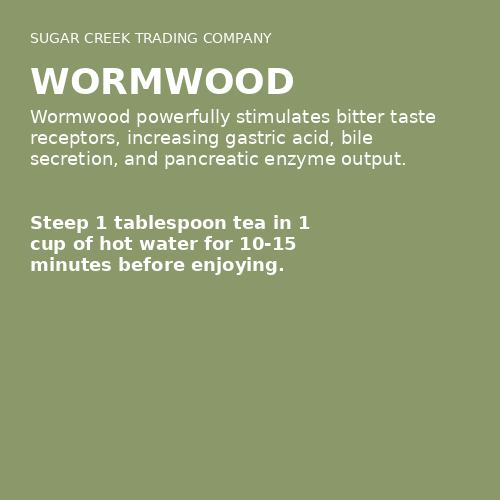
Wormwood powerfully stimulates bitter taste receptors, increasing gastric acid, bile secretion, and pancreatic enzyme output. Sesquiterpene lactones and volatile oils disrupt parasite metabolism and microbial membranes.
At low doses, it sharpens digestion and appetite. At higher doses, thujone antagonizes GABA receptors, producing CNS excitation — the basis of both its stimulant effects and its toxicity.
ACTIONS AND INDICATIONS
Artemisia absinthium acts as a potent digestive bitter, vermifuge, antimicrobial, hepatic stimulant, and carminative. It is indicated for short-term use in intestinal parasitism, profound digestive stagnation, hypochlorhydria, anorexia, microbial imbalance, and sluggish bile flow.
PREPARATIONS AND DOSAGE
| Form | Preparation | Suggested Dose | Notes |
|---|---|---|---|
| Infusion | ¼–½ tsp dried herb per cup hot water; steep 5–10 min | 1 cup, 1–2× daily | Very bitter; short-term |
| Tincture (1:5, 60–70%) | Dried aerial parts | 0.5–1 mL, 1–2× daily | Preferred for precision |
| Powder | Encapsulated herb | 100–300 mg daily | Antiparasitic protocols |
| External wash | Strong infusion | Apply externally | Insect repellent |
SAFETY, CONTRAINDICATIONS, AND TOXICITY
Wormwood must be used with strict restraint.
It is contraindicated during pregnancy, lactation, seizure disorders, kidney disease, and in individuals sensitive to Asteraceae plants. Long-term or high-dose use may result in nausea, dizziness, tremors, anxiety, insomnia, or seizures due to thujone content.
Avoid concurrent use with alcohol, anticonvulsants, benzodiazepines, or other CNS-active drugs.
General Toxicological Reference (LD₅₀)
-
α-Thujone (isolated compound):
Oral LD₅₀ in rats reported in the range of 40–60 mg/kg -
β-Thujone (isolated compound):
Oral LD₅₀ in rats reported around 80–90 mg/kg -
Whole Artemisia absinthium extracts:
Significantly higher LD₅₀ values than isolated thujone, reflecting lower concentration and phytochemical buffering; precise LD₅₀ varies by extraction method but is generally >1,000 mg/kg (oral, animal models)
Clinical relevance:
Whole-plant preparations are substantially less toxic than isolated thujone, but accumulation and chronic use still pose neurological risk. Wormwood is therefore best used short-term, low-dose, and under skilled guidance.
HARVEST AND PROCESSING
Aerial parts are harvested just before or at early flowering when bitter compounds peak. Material is dried quickly in shade and stored airtight. Potency is retained for 1–2 years.
SUSTAINABILITY AND CONSERVATION
Artemisia absinthium is abundant and easily cultivated. While not at conservation risk, its allelopathic effects warrant controlled planting to avoid ecological suppression.
SUMMARY
Wormwood is a boundary plant — medicine and poison separated only by dose, timing, and intention. Used wisely, it clears stagnation, expels parasites, and restores digestive fire where gentler herbs fail.
Its teaching is discipline. Artemisia absinthium heals not through comfort, but through clarity — demanding respect, precision, and restraint from those who work with it.
Share