Sugar Creek Trading Company
Yarrow Flower
Yarrow Flower
Couldn't load pickup availability
ACHILLEA MILLEFOLIUM
(Yarrow Flower, Milfoil, Soldier’s Woundwort)
Family: Asteraceae
Part Used: Flowering tops (primarily flowers; leaves secondary)
Energetics: Cooling to neutral, drying, dispersing
Taste: Bitter, aromatic, slightly pungent
BOTANICAL IDENTIFICATION
Scientific Name: Achillea millefolium L.
Common Names: Yarrow, Milfoil, Soldier’s Woundwort
Family: Asteraceae
Morphology:
Achillea millefolium is a perennial herbaceous plant reaching 30–90 cm (1–3 ft) in height. The stems are erect and finely pubescent, arising from creeping rhizomes. Leaves are deeply dissected, feathery, and aromatic, giving rise to the name millefolium (“thousand leaves”).
The flowers are borne in flat-topped corymbs composed of many small composite heads. Each head contains white to pink ray florets surrounding yellow disk florets. Flowering occurs from late spring through summer, with peak medicinal potency at full bloom.
Root system:
A shallow but spreading rhizomatous root network that enables rapid colonization and resilience under grazing or disturbance.
HABITAT, RANGE, AND ADAPTATIONS
Yarrow is native to Europe, western Asia, and North Africa, and is now naturalized throughout North America and temperate regions worldwide.
It thrives in meadows, grasslands, roadsides, and disturbed soils, preferring full sun and well-drained substrates. Yarrow is drought-tolerant and highly adaptable.
Key adaptations include aromatic volatile oils and bitter compounds that deter herbivores and pathogens. The plant’s rhizomatous growth habit allows rapid regeneration after cutting or trampling.
CULTIVATION AND ECOLOGY
Achillea millefolium is easy to cultivate and often used in permaculture and companion planting. It tolerates poor soils, enhances soil structure, and attracts beneficial insects such as predatory wasps and pollinators.
Ecologically, yarrow functions as a keystone meadow species, improving biodiversity and stabilizing soil. The flowers are an important nectar source, while the foliage contributes to pest balance in agricultural systems.
TRADITIONAL AND ETHNOBOTANICAL USE
Yarrow has one of the longest continuous records of use in Western ethnobotany. Its genus name, Achillea, references Achilles, who was said to use yarrow to treat battlefield wounds.
Across European, Native American, and Asian traditions, yarrow flower was employed as a styptic, febrifuge, digestive bitter, and women’s herb. Native American tribes used yarrow for wound care, fever, colds, menstrual regulation, and pain, while European herbalists relied on it for bleeding control, digestive complaints, and respiratory infections.
In traditional Chinese medicine, related Achillea species were used for blood regulation and divination (yarrow stalks of the I Ching).
Modern herbalists continue to emphasize the flowering tops for regulating circulation, inflammation, and fever, and for restoring balance where systems alternate between excess and deficiency.
KEY BIOACTIVE COMPOUNDS AND BENEFITS
| Compound Class | Representative Compounds | Role in Plant | Human Benefits |
|---|---|---|---|
| Volatile oils | Azulene, chamazulene, cineole, borneol | Defense against herbivores and microbes | Anti-inflammatory, antispasmodic |
| Sesquiterpene lactones | Achillin, millefin | Bitter defense compounds | Hemostatic, anti-inflammatory |
| Flavonoids | Apigenin, luteolin, quercetin | UV protection and oxidative buffering | Antioxidant, capillary-strengthening |
| Alkaloids | Achilleine | Wound defense and tissue signaling | Styptic, bleeding control |
| Tannins | Condensed tannins | Tissue protection and pest deterrence | Astringent, tissue-toning |
| Coumarins | Umbelliferone | Growth regulation and defense | Mild anticoagulant, circulatory support |
The blue sesquiterpene chamazulene forms during distillation from matricin and is responsible for yarrow’s potent anti-inflammatory action.
HOW IT WORKS IN THE BODY
Circulatory and Hemostatic Regulation:
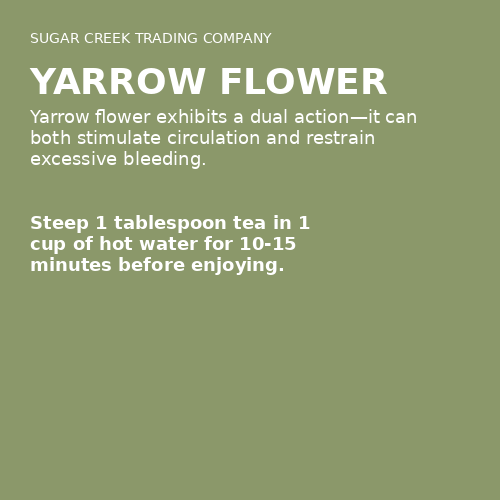
Yarrow flower exhibits a dual action—it can both stimulate circulation and restrain excessive bleeding. Alkaloids and tannins promote clotting when bleeding is excessive, while flavonoids and volatile oils improve peripheral circulation.
Fever and Immune Response:
Yarrow acts as a diaphoretic, opening peripheral blood vessels and encouraging gentle sweating to reduce fever without suppressing immune function.
Digestive and Nervous System Effects:
Bitter compounds stimulate digestion, while aromatic oils relax smooth muscle, reducing spasms and cramping.
ACTIONS AND INDICATIONS
Achillea millefolium flower acts as a hemostatic, diaphoretic, anti-inflammatory, antispasmodic, bitter tonic, and circulatory regulator.
It is indicated for fever (especially colds and flu), acute infections, nosebleeds, heavy or irregular menstruation, digestive cramping, inflammatory conditions, wounds, bruises, and early-stage illness requiring immune mobilization.
PREPARATIONS AND DOSAGE
| Form | Preparation | Suggested Dose | Notes |
|---|---|---|---|
| Infusion | 1–2 tsp dried flowers per cup hot water; steep 10–15 min | 1 cup, up to 3× daily | Best for fever and digestion |
| Tincture (1:5, 40–60%) | Fresh flowering tops | 2–4 mL, 2–3× daily | Broad systemic action |
| Poultice | Fresh flowers crushed | Apply externally | For wounds, bleeding |
| Distilled oil | Steam-distilled | External use | Anti-inflammatory |
| Sitz bath | Strong infusion | As needed | Pelvic and uterine tone |
Yarrow pairs well with Elderflower, Peppermint, Boneset, and Ginger for febrile states, and with Shepherd’s Purse or Raspberry Leaf for bleeding disorders.
SAFETY, CONTRAINDICATIONS, AND TOXICITY
Yarrow is generally safe at customary doses. Some individuals may experience allergic reactions, particularly those sensitive to the Asteraceae family.
Avoid high-dose or long-term use during pregnancy, as yarrow may stimulate uterine activity. Large doses may increase photosensitivity in rare cases due to coumarins.
Toxicity:
Low. Adverse effects are uncommon and typically mild.
HARVEST AND PROCESSING
Flowering tops are harvested at full bloom on dry mornings. Material is dried quickly in shade to preserve volatile oils and stored airtight. Properly dried flowers retain potency for 1–2 years.
SUSTAINABILITY AND CONSERVATION
Achillea millefolium is abundant, resilient, and highly sustainable. Ethical harvesting involves taking only the upper flowering portions and allowing plants to regenerate.
Yarrow is well-suited to regenerative agriculture, pollinator gardens, and soil restoration projects.
SUMMARY
Yarrow flower is a master regulator—a plant that moves what is stagnant, restrains what is excessive, and restores equilibrium where systems have lost rhythm.
From battlefield wounds to fevered bodies, Achillea millefolium has earned its reputation as a guardian herb, bridging circulation, immunity, and repair. Its intelligence lies not in force, but in balance—making it indispensable in both acute care and long-term restoration.
Share