Sugar Creek Trading Company
Yerba Santa Leaf
Yerba Santa Leaf
Couldn't load pickup availability
ERIODICTYON CALIFORNICUM
(Yerba Santa, Holy Herb, Mountain Balm)
Family: Boraginaceae (formerly Hydrophyllaceae)
Part Used: Leaf
Energetics: Warming, drying, dispersing
Taste: Bitter-sweet, resinous, balsamic
BOTANICAL IDENTIFICATION
Scientific Name: Eriodictyon californicum (Hook. & Arn.) Torr.
Common Names: Yerba Santa, Holy Herb, Mountain Balm
Family: Boraginaceae
Morphology:
Eriodictyon californicum is an evergreen to semi-evergreen woody shrub reaching 1–2.5 meters (3–8 ft) in height. Leaves are elongate, lanceolate to elliptic, thick, leathery, and strongly aromatic when crushed. The upper surface is dark green and glossy; the underside is densely covered with fine, woolly hairs that reduce transpiration.
Flowers are funnel-shaped, pale lavender to white, borne in clustered cymes at branch tips, blooming in late spring to early summer. The plant spreads via rhizomes and forms dense colonies following disturbance.
Root system:
A deep, spreading rhizomatous root network adapted to dry slopes and chaparral soils.
HABITAT, RANGE, AND ADAPTATIONS
Yerba Santa is native to California and northern Baja California, inhabiting chaparral, coastal sage scrub, dry woodlands, and montane slopes.
It thrives in well-drained, rocky, or sandy soils, often in fire-prone ecosystems. Adaptations include resinous leaf coatings, woolly trichomes, and deep roots that reduce water loss and confer drought tolerance. After fire or disturbance, Yerba Santa regenerates aggressively, stabilizing soil and restoring habitat.
Resinous compounds serve as chemical defenses against herbivores, insects, and microbial pathogens.
CULTIVATION AND ECOLOGY
Yerba Santa is slow to establish but highly resilient once rooted. It propagates through seed and rhizome division. The plant prefers full sun to partial shade and minimal irrigation once established.
Ecologically, it is a pioneer and stabilizer species in chaparral systems, aiding post-fire recovery and erosion control. Its flowers support native pollinators, and dense growth provides shelter for wildlife.
TRADITIONAL AND ETHNOBOTANICAL USE
Yerba Santa has a long and well-documented history among Indigenous peoples of California, including Chumash, Ohlone, Miwok, Pomo, and Cahuilla nations.
The leaf was traditionally chewed, infused, or smoked for coughs, asthma, bronchitis, and respiratory congestion. It was also used ceremonially and medicinally for fatigue, rheumatism, wounds, and pain, earning the Spanish name Yerba Santa (“holy herb”) due to its perceived healing power.
During the 19th century, Yerba Santa entered Western medicine as a respiratory remedy and bitter flavor-corrective, used to mask the taste of quinine and other bitter medicines. Eclectic physicians prescribed it for chronic bronchitis, tuberculosis-associated cough, and allergic asthma.
Modern herbalists continue to value Yerba Santa as a lung tonic and expectorant, particularly where congestion is thick, sticky, or resistant.
KEY BIOACTIVE COMPOUNDS AND BENEFITS
| Compound Class | Representative Compounds | Role in Plant | Human Benefits |
|---|---|---|---|
| Flavonoids | Eriodictyol, homoeriodictyol | UV protection and oxidative stress buffering | Anti-inflammatory, antioxidant, bronchodilatory |
| Resinous phenolics | Eriodictyone, eriodictyl chalcones | Antimicrobial defense and wound sealing | Expectorant, antimicrobial |
| Volatile oils | Monoterpenes, sesquiterpenes | Herbivore deterrence and pathogen defense | Decongestant, antiseptic |
| Tannins | Condensed tannins | Tissue protection and astringency | Reduces excess mucus, soothes inflamed tissue |
| Glycosides | Flavonoid glycosides | Compound storage and transport | Sustained respiratory support |
Eriodictyol has been studied for its ability to modulate sensory bitterness receptors, explaining Yerba Santa’s historical use as a flavor modifier in medicine.
HOW IT WORKS IN THE BODY
Respiratory System:
Yerba Santa acts as a stimulating expectorant, thinning thick mucus while promoting effective cough reflex. Resinous compounds loosen bronchial secretions, while tannins reduce excessive mucus production and soothe irritated membranes.
Inflammation and Allergy Modulation:
Flavonoids inhibit inflammatory mediators and oxidative stress in lung tissue, making the plant particularly useful in asthma, allergic bronchitis, and chronic cough.
Taste and Digestive Reflexes:
Bitter principles stimulate vagal and digestive reflexes that indirectly enhance respiratory secretion clearance.
ACTIONS AND INDICATIONS
Eriodictyon californicum functions as an expectorant, respiratory tonic, anti-inflammatory, antimicrobial, bitter stimulant, and mild analgesic.
It is indicated for chronic bronchitis, asthma, lingering cough after infection, upper respiratory congestion, allergic respiratory conditions, tuberculosis-associated cough (historical use), and thick, adherent mucus.
PREPARATIONS AND DOSAGE
| Form | Preparation | Suggested Dose | Notes |
|---|---|---|---|
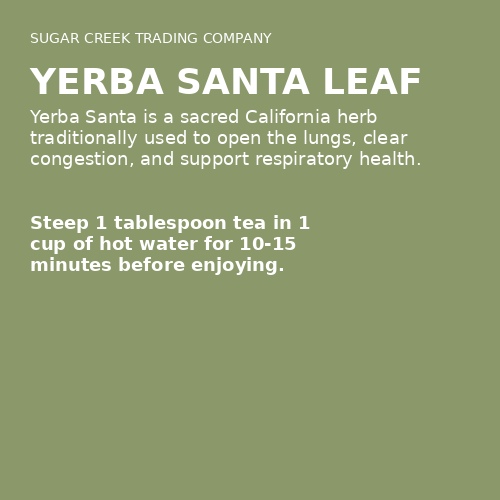
| Infusion | 1–2 tsp dried leaf per cup hot water; steep 10–15 min | 1 cup, up to 3× daily | Bitter-sweet, resinous |
| Tincture (1:5, 40–60%) | Fresh or dried leaf | 2–4 mL, 2–3× daily | Preferred for chronic lung conditions |
| Syrup | Infusion reduced with honey | 1–2 tsp as needed | Useful for cough and asthma |
| Smoking blend (traditional) | Dried leaf | Occasional use | Folk use only; not advised clinically |
| Topical wash | Strong infusion | Apply externally | For wounds and inflammation |
Yerba Santa pairs well with Mullein, Elecampane, Wild Cherry Bark, and Licorice for comprehensive respiratory formulas.
SAFETY, CONTRAINDICATIONS, AND TOXICITY
Yerba Santa is generally safe at customary doses. Large amounts may cause gastrointestinal irritation or nausea due to resin content.
Avoid excessive use during pregnancy due to insufficient safety data. Use caution in individuals with severe gastric irritation or reflux.
No well-documented drug interactions are known.
Toxicity:
Low. Adverse effects are uncommon and typically mild.
HARVEST AND PROCESSING
Leaves are harvested in late spring through summer. Only mature leaves should be taken, leaving sufficient foliage for plant recovery. Leaves are dried in thin layers away from direct sun and stored airtight.
Properly dried leaf retains potency for 1–2 years.
SUSTAINABILITY AND CONSERVATION
Yerba Santa is locally abundant but vulnerable to habitat loss and overharvesting in some regions. Ethical sourcing emphasizes selective wild-harvest, rotational gathering, and cultivation where feasible.
As a fire-adapted species, it plays a key role in ecosystem regeneration, erosion control, and pollinator support in chaparral landscapes.
SUMMARY
Eriodictyon californicum is a resinous lung ally, warming and drying where stagnation and congestion take hold. It excels when mucus is thick, sticky, and persistent, restoring movement and clarity to the respiratory passages.
Rooted in Indigenous Californian ethnobotany and validated by phytochemical insight, Yerba Santa stands as one of North America’s most effective respiratory tonics, embodying the strength, resilience, and restorative intelligence of chaparral medicine.
Share