Sugar Creek Trading Company
Yohimbe Bark
Yohimbe Bark
Couldn't load pickup availability
Pausinystalia yohimbe (K.Schum.) Pierre ex Beille
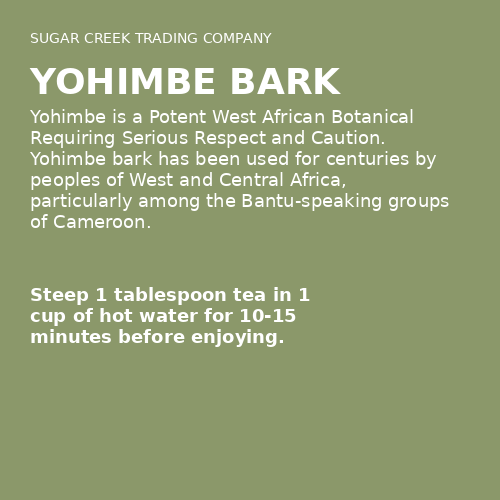
Yohimbe Bark — A Potent West African Botanical Requiring Serious Respect and Caution
Botanical Identification
- Common Names: Yohimbe, Yohimbe Bark, Johimbe, Pausinystalia
- Latin Binomial: Pausinystalia yohimbe (K.Schum.) Pierre ex Beille
- Family: Rubiaceae
- Part Used: Inner bark of the trunk and branches
- Origin: Tropical West Africa — primarily Cameroon, Nigeria, Gabon, and the Congo Basin
- Appearance: Reddish-brown to grayish-brown bark chips or shredded pieces
- Flavor: Very bitter, astringent, with a sharp, somewhat unpleasant aftertaste
Cultural and Historical Use
Yohimbe bark has been used for centuries by peoples of West and Central Africa, particularly among the Bantu-speaking groups of Cameroon. Traditionally, it was prepared as a bark tea or chewed directly during long hunts, ceremonial dances, and rites of passage. The bark was valued as a stimulant, aphrodisiac, and endurance enhancer. Among the Bulu and Ewondo peoples of Cameroon, yohimbe preparations were consumed before warrior rituals and marriage ceremonies.
European explorers and colonial-era botanists documented the bark in the late 19th century. The German pharmacologist Leopold Spiegel isolated the primary alkaloid yohimbine in 1896. By the early 20th century, yohimbine hydrochloride had entered European pharmacology as one of the first pharmacological treatments for erectile dysfunction — decades before sildenafil (Viagra) was developed.
Yohimbine HCl remains a prescription medication in several countries and is FDA-recognized as a drug compound (not classified as a dietary supplement when in pure isolated form). The whole bark, however, is sold as an herbal product and contains yohimbine alongside numerous other alkaloids that modulate its effects.
Key Bioactive Compounds
| Compound | Class | Notes |
|---|---|---|
| Yohimbine | Indole alkaloid | Primary active alkaloid; potent alpha-2 adrenergic antagonist; concentration varies widely (0.5-6% in bark) |
| Corynanthine (rauwolscine) | Indole alkaloid | Stereoisomer of yohimbine with alpha-2 blocking activity; sometimes called "alpha-yohimbine" |
| Ajmalicine (raubasine) | Indole alkaloid | Mild vasodilator; found in lower concentrations; also present in Rauwolfia species |
| Allo-yohimbine | Indole alkaloid | Related alkaloid contributing to the overall pharmacological profile |
| Tannins | Polyphenols | Astringent compounds; contribute to the bitter taste and may slow alkaloid absorption |
How It Works in the Body
Yohimbine, the principal alkaloid, is a selective alpha-2 adrenergic receptor antagonist. Alpha-2 receptors normally act as "brakes" on the sympathetic nervous system — when yohimbine blocks these receptors, it releases the brake, resulting in increased norepinephrine (noradrenaline) release throughout the body. This produces a cascade of physiological effects:
- Cardiovascular: Increased heart rate, elevated blood pressure, and increased cardiac output. These effects can be significant and are the primary source of safety concerns.
- Sexual function: Increased blood flow to the genitals through a combination of peripheral vasodilation and central nervous system stimulation. This is the basis for its historical use as an aphrodisiac and the clinical use of yohimbine HCl for erectile dysfunction.
- Lipolysis: Alpha-2 blockade in adipose tissue facilitates fat mobilization, which has made yohimbine of interest in weight loss and body composition contexts.
- Central nervous system: Increased norepinephrine activity produces heightened alertness, arousal, and in some individuals, anxiety or panic. Yohimbine is actually used in clinical research to experimentally induce anxiety and panic attacks for study purposes.
The whole bark contains a complex of alkaloids that may partially buffer yohimbine's effects. However, alkaloid concentration in raw bark is highly variable, making precise dosing difficult and increasing the importance of caution.
Dose Guidelines
IMPORTANT: Yohimbe bark has a narrow therapeutic window. The difference between an effective dose and an uncomfortable or dangerous dose is small. Start at the lowest possible amount and increase only with great caution.
| Preparation | Amount | Frequency / Notes |
|---|---|---|
| Bark tea (decoction) | 1/2 to 1 teaspoon bark simmered in 8 oz water for 10 minutes | Start with half a cup; do NOT take more than one cup in a day until individual response is well understood |
| Tincture (1:5, 50% ethanol) | 0.5-2 mL (10-40 drops) | Start at 10 drops and assess response over 2 hours before taking more |
| Clinical reference (yohimbine HCl) | 5.4-10 mg yohimbine alkaloid, 3x daily | This is the pharmaceutical dosing; NOT directly translatable to raw bark due to variable alkaloid content |
Preparation and Uses
- Decoction: Simmer 1/2 to 1 teaspoon of bark chips in 8 ounces of water for 10 minutes. Strain thoroughly. The tea is extremely bitter. Start with a small amount (half a cup or less) to assess tolerance. Do not combine with sweeteners that may encourage overconsumption.
- Tincture: A tincture provides slightly more consistent dosing than tea, though alkaloid content in the starting bark still varies. Begin with 10-15 drops in water and wait at least 2 hours before considering an additional dose.
- Traditional Preparation: In West Africa, the bark is sometimes soaked in palm wine or chewed directly. These traditional contexts typically involved community supervision and cultural knowledge of appropriate dosing.
Optimal Context for Use
- Traditional use as a male aphrodisiac and sexual tonic — this is the primary historical application
- Short-term use for energy and stimulation in individuals who have confirmed they tolerate it well
- Athletic and body composition contexts — some users take it for its lipolytic properties, though evidence is mixed
- This is NOT a casual daily herb. It should be approached with the same seriousness as any potent pharmacological substance.
Sustainability and Ethical Harvesting
Pausinystalia yohimbe is under increasing pressure in its native West African habitat. The tree grows slowly in tropical lowland forests, and decades of intensive bark harvesting — driven by global demand for yohimbine — have led to significant population declines. The species is now classified as Vulnerable on the IUCN Red List.
Unsustainable harvesting practices, including complete debarking that kills the tree, are widespread in Cameroon and Nigeria. Consumers should actively seek bark sourced from cultivated plantations or from suppliers who can document sustainable wildcrafting practices. Supporting reforestation initiatives in West Africa and purchasing from ethical supply chains helps protect this increasingly threatened species.
Safety and Cautions
CRITICAL SAFETY WARNINGS — READ CAREFULLY BEFORE USE:
- CARDIOVASCULAR EFFECTS: Yohimbe bark can significantly raise blood pressure and heart rate. Individuals with hypertension, heart disease, cardiac arrhythmias, or any cardiovascular condition must NOT use this product. Dangerous hypertensive crises have been reported.
- ANXIETY AND PANIC: Yohimbine increases norepinephrine release and can trigger severe anxiety, panic attacks, and agitation. Individuals with anxiety disorders, PTSD, panic disorder, or any psychiatric condition should NOT use yohimbe bark.
-
DRUG INTERACTIONS — SERIOUS: Yohimbe has dangerous interactions with many medications:
- MAO inhibitors: Potentially fatal hypertensive crisis. ABSOLUTELY contraindicated.
- Antidepressants (SSRIs, SNRIs, tricyclics): Increased risk of serotonergic effects and blood pressure spikes.
- Blood pressure medications: Unpredictable interactions — yohimbe can both oppose and exaggerate their effects depending on the class of drug.
- Stimulants (caffeine, amphetamines, decongestants): Compounded cardiovascular stress. Do not combine yohimbe with high doses of caffeine or any stimulant medications.
- Erectile dysfunction drugs (sildenafil, tadalafil): Combining vasodilators with yohimbe creates unpredictable blood pressure effects.
- KIDNEY AND LIVER DISEASE: Yohimbine is metabolized by the liver and excreted by the kidneys. Impaired organ function can lead to dangerous accumulation. Do not use with kidney or liver disease.
- PREGNANCY AND BREASTFEEDING: Absolutely contraindicated. Yohimbine can affect uterine blood flow and crosses into breast milk.
- CHILDREN: Not appropriate for children under any circumstances.
- DIABETES: Yohimbine may interfere with blood sugar regulation and insulin activity. Diabetics should avoid use or consult their physician.
- VARIABLE ALKALOID CONTENT: Studies have shown that yohimbe bark products vary enormously in alkaloid content — sometimes by a factor of 10 or more between batches. This makes precise self-dosing very difficult. Always start with the smallest possible amount.
- Signs of overdose include rapid heartbeat, severe headache, chest pain, nausea, vomiting, tremors, anxiety, and dangerously elevated blood pressure. Seek emergency medical attention immediately if these symptoms occur.
References
- Tam, S. W., et al. "Yohimbine: a clinical review." Pharmacology and Therapeutics, 91(3), 2001.
- Cohen, P. A., et al. "Quantity of yohimbe alkaloids in dietary supplements." Drug Testing and Analysis, 8(3-4), 2016.
- Ernst, E. and Pittler, M. H. "Yohimbine for erectile dysfunction: a systematic review and meta-analysis of randomized clinical trials." Journal of Urology, 159(2), 1998.
- Goldberg, M. R. and Robertson, D. "Yohimbine: a pharmacological probe for study of the alpha-2 adrenoreceptor." Pharmacological Reviews, 35(3), 1983.
- Charney, D. S., et al. "Yohimbine induced anxiety and increased noradrenergic function in humans: effects of diazepam and clonidine." Life Sciences, 32(12), 1983.
- Sax, L. "Yohimbine does not affect fat distribution in men." International Journal of Obesity, 15(9), 1991.
- IUCN Red List Assessment: Pausinystalia yohimbe. Vulnerable status, assessed 2018.
NOTICE: Yohimbe bark is a potent botanical with significant pharmacological activity. It is sold as a raw herbal product for informed adults only. It is not intended to diagnose, treat, cure, or prevent any disease. The cardiovascular and psychological effects of yohimbine are well-documented and can be serious. Consult a licensed healthcare provider before use, especially if you have any medical conditions or take any medications. If you experience rapid heartbeat, chest pain, severe headache, or panic, discontinue use immediately and seek emergency medical care.
Share