Sugar Creek Trading Company
Yucca Root
Yucca Root
Couldn't load pickup availability
YUCCA SCHIDIGERA
(Yucca Root, Mojave Yucca, Soaproot)
Family: Asparagaceae (formerly Agavaceae / Liliaceae)
Part Used: Root (rhizome)
Energetics: Cooling, drying, dispersing
Taste: Bitter, slightly sweet, soapy
BOTANICAL IDENTIFICATION
Scientific Name: Yucca schidigera Roezl ex Ortgies
Common Names: Yucca, Mojave Yucca, Soaproot
Family: Asparagaceae
Morphology:
Yucca schidigera is an evergreen, perennial, arborescent yucca native to desert regions. It typically grows as a short trunked or multi-headed shrub, reaching 3–6 meters (10–20 ft) in height. Leaves are rigid, sword-shaped, fibrous, and sharply pointed, forming dense terminal rosettes. The leaf margins are smooth to finely fibrous, and the leaf surface is thickly cuticularized to reduce transpiration.
The flowering stalk emerges from the center of mature rosettes, producing large, pendulous clusters of creamy-white, bell-shaped flowers. Pollination is achieved through a highly specialized mutualism with the yucca moth.
Root system:
The medicinal portion consists of a thick, fibrous rhizome and extensive root mass, rich in steroidal saponins. Roots penetrate deeply into desert substrates, anchoring the plant and accessing minerals unavailable to shallow-rooted species.
HABITAT, RANGE, AND ADAPTATIONS
Yucca schidigera is native to the Mojave and Sonoran Deserts of the southwestern United States and northern Mexico. It thrives in arid, rocky, and sandy soils, often on slopes, mesas, and desert scrublands.
Adaptations include CAM photosynthesis, which minimizes water loss, a waxy cuticle that reflects solar radiation, and a deep root system capable of extracting moisture and minerals from poor soils. The plant’s high saponin concentration functions as a chemical defense against herbivores, insects, and microbial pathogens.
CULTIVATION AND ECOLOGY
Yucca schidigera is slow-growing but extremely long-lived, often surviving for decades in harsh desert conditions. It reproduces via seed and vegetative offsets, though natural regeneration is slow.
Ecologically, the species is a keystone plant in desert ecosystems. Its obligate relationship with the yucca moth represents one of the most studied examples of plant–insect coevolution. Yucca contributes to soil stabilization, provides shelter for desert fauna, and supports pollinator biodiversity.
TRADITIONAL AND ETHNOBOTANICAL USE
Yucca schidigera has been used extensively by Indigenous peoples of the American Southwest, including Mojave, Cahuilla, Chemehuevi, Hopi, and Apache nations.
Traditionally, the root was crushed and agitated in water to create a natural soap, used for cleansing the body, hair, ceremonial objects, and textiles. Medicinally, decoctions and washes were employed for joint pain, inflammation, arthritis, skin disorders, and wound care.
Yucca was regarded as a blood and lymph cleanser, believed to draw stagnation and “toxins” from the joints and tissues. Externally, poultices and washes were used for sprains, swellings, and inflammatory skin conditions.
In contemporary herbal practice, Yucca schidigera is primarily valued as a systemic anti-inflammatory and metabolic cleansing agent, especially for degenerative joint conditions and chronic inflammatory states.
KEY BIOACTIVE COMPOUNDS AND BENEFITS
| Compound Class | Representative Compounds | Role in Plant | Human Benefits |
|---|---|---|---|
| Steroidal saponins | Sarsasapogenin, smilagenin, yuccasaponins | Chemical defense against herbivory and pathogens | Anti-inflammatory, anti-arthritic, cholesterol-binding |
| Polyphenols | Yuccaols A–E, resveratrol analogs | UV protection and oxidative stress mitigation | Antioxidant, anti-inflammatory |
| Steroidal glycosides | Various sapogenin glycosides | Structural regulation and defense | Modulate inflammatory pathways |
| Polysaccharides | — | Energy storage and cellular resilience | Mild immunomodulatory support |
| Minerals | Calcium, potassium, magnesium | Structural integrity and stress tolerance | Bone and metabolic support |
Yucca’s steroidal saponins are structurally similar to human steroid hormones, contributing to their influence on inflammatory signaling, joint integrity, and metabolic balance.
HOW IT WORKS IN THE BODY
Inflammation and Joint Health:
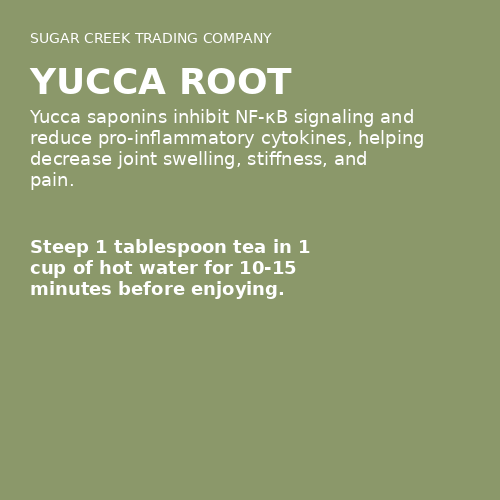
Yucca saponins inhibit NF-κB signaling and reduce pro-inflammatory cytokines, helping decrease joint swelling, stiffness, and pain. By binding bile acids and cholesterol in the gut, they indirectly reduce systemic inflammatory burden.
Detoxification and Metabolic Effects:
The surfactant nature of saponins enhances the elimination of metabolic waste through the liver and intestines. This mechanism underlies yucca’s traditional reputation as a cleanser of the blood and lymph.
Digestive Influence:
At low doses, yucca supports digestion and fat metabolism. At higher doses, saponins can irritate the gastrointestinal lining, necessitating careful, conservative dosing.
ACTIONS AND INDICATIONS
Yucca schidigera acts as an anti-inflammatory, anti-arthritic, lymphatic and blood cleanser, metabolic modulator, and mild laxative.
It is indicated for osteoarthritis, degenerative joint disease, gout, joint stiffness, chronic inflammation, metabolic waste accumulation, and toxin-related fatigue, as well as select inflammatory skin conditions.
PREPARATIONS AND DOSAGE
| Form | Preparation | Suggested Dose | Notes |
|---|---|---|---|
| Decoction | ½–1 tsp dried root per cup water; simmer 20–30 min | 1 cup daily | Strong; short-term use preferred |
| Tincture (1:5, 40–60%) | Dried root | 1–2 mL, 1–2× daily | Begin low and increase slowly |
| Capsules / Powder | Standardized root powder | 300–600 mg daily | Common in joint formulas |
| Topical wash | Decoction or diluted extract | Apply externally | For inflammatory skin conditions |
Yucca schidigera pairs well with White Willow, Devil’s Claw, Turmeric, and Burdock Root in chronic inflammatory and joint-support formulations.
SAFETY, CONTRAINDICATIONS, AND TOXICITY
Yucca is generally safe at low to moderate doses, but excessive intake may cause gastrointestinal irritation, nausea, or diarrhea due to saponin content.
Avoid use during pregnancy and lactation due to insufficient safety data. Use caution in individuals with intestinal inflammation, ulcers, or malabsorption syndromes.
Yucca may potentiate the effects of cholesterol-lowering medications due to bile acid binding.
Toxicity:
Low when used appropriately. Adverse effects are primarily gastrointestinal and reversible upon discontinuation.
HARVEST AND PROCESSING
Roots are harvested from mature plants, traditionally in late fall. After cleaning, they are sliced and dried at low heat (<110°F / 43°C). Properly processed root retains potency for 2–3 years when stored airtight and away from light.
Given the plant’s slow growth, cultivated or sustainably managed sources are strongly preferred.
SUSTAINABILITY AND CONSERVATION
While Yucca schidigera is not currently endangered, its slow regeneration rate makes wild populations vulnerable to overharvesting. Ethical sourcing emphasizes cultivation, selective harvesting, and minimal ecological disturbance.
Yucca plays a critical role in desert ecosystems, contributing to soil stabilization, pollinator coevolution, and habitat integrity, making conservation-conscious use essential.
SUMMARY
Yucca schidigera is a desert-rooted anti-inflammatory, cooling and cleansing where stagnation accumulates. Its saponins dissolve congestion in joints and tissues, restoring movement and metabolic flow.
Anchored in Indigenous ethnobotanical knowledge and supported by modern research, this species stands as a powerful ally for chronic inflammation, joint degeneration, and systemic overload, embodying the resilience and precision of arid-land medicine.
Share